

- Home
- What does an EICR check?
What does an electrical safety check (EICR) actually check?
The fuse board, the wiring, the earthing and a sample of your fittings, then seven tests with the power off and on. Here is what each part means, what the codes mean, who legally needs one, and what we find in real homes.
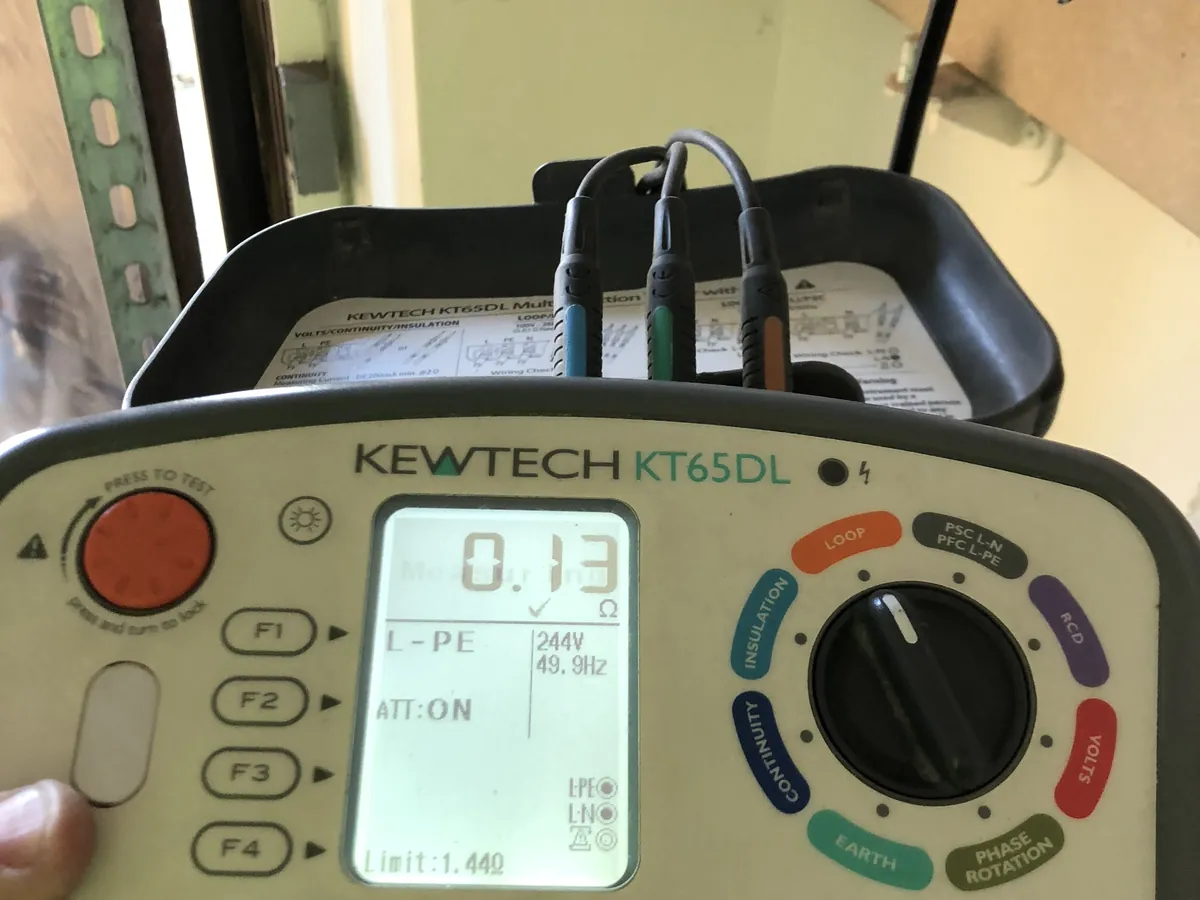
What the electrician looks at
- The consumer unit (fuse board): its condition, whether the right protective devices are fitted, signs of overheating, and whether the circuits are labelled.
- Earthing and bonding: the main earth, and the bonding to incoming gas and water pipes.
- Sockets, switches and light fittings: cracks, scorch marks, loose fronts, and fittings in the wrong place, such as sockets too close to a bath.
- Signs of heat: discoloured plastic, melted insulation or a burning smell at accessories and connections.
The electrician does not take every fitting apart. They open up an agreed sample, and look further if the sample turns up problems. The extent of the inspection, and anything agreed as a limitation (for example a locked room or a board that cannot be switched off), is written on the report, so you know exactly what was and wasn’t checked.
The tests, in plain English
Dead tests are done with the power off. Live tests need the power on and are done with the right test equipment and precautions.
| Test | Power | What it tells you |
|---|---|---|
| Continuity of protective conductors | Off | Every earth wire is connected, all the way back to the consumer unit. |
| Continuity of ring final circuits | Off | Each socket ring is one unbroken loop, with no loose or crossed connections. |
| Insulation resistance | Off | The plastic around the conductors is not breaking down, so current is not leaking where it shouldn’t. |
| Polarity | Off | Switches, fuses and breakers are in the live conductor, not the neutral. |
| Earth fault loop impedance | On | If a fault happens, enough current will flow to trip the breaker or blow the fuse quickly. |
| Prospective fault current | On | The devices on the board can safely cut off the biggest fault current your supply could deliver. |
| RCD trip times | On | Each RCD cuts the power fast enough to protect someone touching a live part. |
What it does not cover
- Plug-in appliances such as kettles, fridges and washing machines. These are checked with a portable appliance test. Social landlords must also have electrical equipment they provide checked at least every five years. See PAT testing.
- Tenants’ own equipment. The guidance says tenants are responsible for making sure their own electrical equipment is safe.
- Gas. Boilers, gas pipework and gas appliances are checked by a Gas Safe registered engineer, not an electrician.
The codes, and what “unsatisfactory” means
| Code | Government guidance wording | What it means for you |
|---|---|---|
| C1 | Danger present. Risk of injury. | Made safe straight away. With your agreement we do this before we leave. |
| C2 | Potentially dangerous. | Remedial work is required. The report is unsatisfactory until it is done. |
| C3 | Improvement recommended. | Not a fail. No remedial work is required. |
| FI | Further investigation required without delay. | Something needs looking at more closely. A landlord must have it carried out. |
Any C1 or C2 makes the report unsatisfactory: it will say the installation is unsatisfactory for continued use. If there are no C1, C2 or FI items, the installation should be safe for continued use, even if there are C3s. See fire alarm grades if your report mentions LD1, LD2 or LD3.
Is an EICR a legal requirement?
Private and social landlords in England: yes. Under regulation 3 of the Electrical Safety Standards in the Private Rented Sector and Social Rented Sector (England) Regulations 2020, a landlord must:
- “ensure every electrical installation in the residential premises is inspected and tested at regular intervals” by a qualified person, meaning “at intervals of no more than 5 years”, or sooner if the last report says so;
- “supply a copy of that report to each existing tenant of the residential premises within 28 days” of the test;
- give a copy to a new tenant “before that tenant occupies those premises”, and to the council “within 7 days” of a written request;
- have any remedial or further investigative work done by a qualified person within 28 days, or “the period specified in the report if less than 28 days”, and send written confirmation to tenants and the council “within 28 days of completion of the further investigative or remedial work”.
Councils can fine a landlord up to £40,000. For social housing tenancies granted before 1 December 2025, the guidance says the first inspection must be done before 1 November 2026. See the social housing EICR deadline and electricians for landlords.
Owner-occupiers: no. The regulations apply to tenancies. Electrical Safety First recommends an inspection at least every 10 years in a home you own. Selling? See do I need an EICR to sell my house?
Commercial premises: no regulation names the EICR, but regulation 4(2) of the Electricity at Work Regulations 1989 says “all systems shall be maintained so as to prevent, so far as is reasonably practicable, such danger”. HSE says installations “should be tested often enough that there is little chance of deterioration leading to danger”. See who is responsible for an EICR on a commercial property.
Local licensing: what councils ask for
If your let needs a licence, the council may also ask to see electrical paperwork with the application. It varies, even between neighbouring councils. Checked 27 October 2026:
| Council | What the licence application asks for | Our local page |
|---|---|---|
| Brent | A Gas Safe certificate and an EPC rated A to E. The application does not ask for an EICR, but the five-yearly EICR duty still applies. | Wembley |
| Bedford Borough (HMOs) | An “electrical safety inspection certificate”, with gas, fire safety and emergency lighting (where installed) certificates. | Bedford |
| Milton Keynes (HMOs) | A valid electrical installation condition report and a PAT certificate for equipment supplied with the tenancy. | Milton Keynes |
| Hillingdon (HMOs) | A valid electrical certificate and a PAT certificate, plus gas and fire alarm certificates, a fire risk assessment and, for 3+ storeys, an emergency lighting certificate. | Uxbridge |
Schemes and application forms change, so always check with the council before you apply.
What we find
We read 101 of our own EICRs on homes, issued between August 2023 and July 2026:
- 81% had nothing to report: no C1, C2, C3 or FI codes at all.
- 9% were unsatisfactory, and none had a C1 “danger present” code.
- Location mattered: 3 of 91 Hertfordshire homes were unsatisfactory, against 6 of 10 London flats.
The same findings came up again and again: smoke alarm cover short of LD2 (7 homes, all London flats), mains smoke alarms with no surge protection (6), older Type AC RCDs (5, coded C2 in four flats) and lighting circuits with no earth wire (5). Read what we found in 101 home EICRs.
How many we do
From July 2024 to October 2026 our job system holds more than 1,250 EICR-type jobs. The main programmes:
| Client | EICR-type jobs | Where (postcode districts) | What they were |
|---|---|---|---|
| Pilon | 828 | Southwark: mainly SE15, SE5 and SE22 | EICR plus LD1 fire alarm upgrade per home, Feb to Aug 2026. See the programme. |
| Wates | 231 | Brent: mainly NW10, HA0, NW2 and HA9 | EICRs on 221 homes, July 2024 to October 2026, still running. See the programme. |
| Novus | 107 | Kempston, MK42 (106); Welwyn Garden City (1) | EICRs, and EICRs with remedials done on the same job, July 2024 to March 2025. |
| Axis Europe | 77 | London, the South East and East of England | EICRs in sheltered and retirement housing, September 2025 to April 2026, including void EICRs. See the work. |
| United Infrastructure | 10 | London: E1, E14, W3, HA0 | Mostly 3-monthly EICRs, one with PAT testing. |
| Mulalley | 9 | Stevenage (SG1) and Welwyn Garden City | 3-monthly EICRs, including on a site set-up, and one EICR after a water leak. |
| Other landlords, homeowners and businesses | 24 | Hertfordshire, London and beyond | Single EICRs, some with remedials or other tests. |
Three kinds of job come up again and again:
- Void EICRs between tenancies, so the home is re-let with a current report.
- EICR and remedials on one job: we test, fix the C1 and C2 items and hand back a satisfactory report. See our work for Novus.
- 3-monthly EICRs for main contractors, including on a contractor’s site set-up in Stevenage. See site set-up.
What it costs
| Property | Landlord EICR (plus VAT) | Homeowner EICR (inc VAT) |
|---|---|---|
| Studio or 1-bed | £130 | £156 |
| 2-bed | £155 | £186 |
| 3-bed | £180 | £216 |
| 4-bed | £215 | £258 |
| 5+ bed | from £265 | from £318 |
| HMO | from £290 | – |
Subject to survey; we confirm the price before booking. Any remedial work is quoted separately, with the report. See how much an EICR costs.
How SEGplc can help
We are an NICEIC Approved Contractor at SEG House, Chiswell Green, testing homes, lets and blocks across Hertfordshire, Bedfordshire, Buckinghamshire and London. You get a clear report and a fixed price for anything that needs doing. See EICR testing, EICRs in St Albans and EICRs in London.
Questions about electrical safety checks
Is an EICR a legal requirement?
For private and social landlords in England, yes: the installation must be inspected and tested by a qualified person at least every five years, and the report given to tenants. For a home you own and live in, no. Electrical Safety First recommends an inspection at least every 10 years. Businesses must maintain their installations under the Electricity at Work Regulations 1989.
What does an electrical safety check involve?
A visual inspection of the consumer unit, wiring, sockets, switches and fittings, with a sample opened up; dead tests with the power off; live tests with the power on; and a written report with any problems coded C1, C2, C3 or FI.
Does an EICR check my appliances?
No. An EICR covers the fixed wiring. Plug-in appliances are checked with a PAT test, and gas appliances by a Gas Safe registered engineer. See PAT testing.
How long does an electrical safety check take?
Around two hours for a 1-bed flat and three to four hours for a typical 3-bed house. The power is off for parts of the visit.
What happens if my EICR is unsatisfactory?
A C1 or C2 code means remedial work is needed. A landlord must have it done by a qualified person within 28 days, or sooner if the report says so, then give written confirmation to the tenants and the council within 28 days of the work. We give you a fixed price for any remedials with the report.
Is a C3 a fail?
No. The government guidance says a C3 does not mean remedial work is required. It is an improvement we recommend, often because the rules have moved on since the house was wired.
Sources
- legislation.gov.uk, Electrical Safety Standards in the Private Rented Sector and Social Rented Sector (England) Regulations 2020, regulation 3
- GOV.UK, Electrical safety standards in the private and social rented sectors: guidance
- legislation.gov.uk, Electricity at Work Regulations 1989, regulation 4
- HSE, Electricity at work: frequently asked questions
- Electrical Safety First, Recommended inspection intervals
- Brent Council, Get licensed: what you need to apply
- Bedford Borough Council, Apply for an HMO licence
- Milton Keynes City Council, Houses in multiple occupation (HMO)
- Hillingdon Council, Apply for an HMO licence form
Written by SEGplc, NICEIC Approved Contractor, SEG House, Chiswell Green, St Albans. Job figures from our job system, July 2024 to October 2026. Last updated 27 October 2026. This is general guidance, not legal advice.
Need it done by a date?
Tell us the deadline. We’ll tell you honestly whether we can hit it — and we usually can.