

- Home
- Do I need an EICR to sell my house?
Do I need an EICR to sell my house?
Not by law. But the buyer’s solicitor will ask about the electrics, and the right paperwork keeps the sale moving. Here is what they ask, when an EICR helps and what it costs.
The short answer
No. In England there is no legal requirement to have an Electrical Installation Condition Report (EICR) to sell a home you live in. But the buyer’s solicitor will ask about the electrics, and a missing certificate or an old installation can hold a sale up. A recent EICR answers those questions before anyone asks them.
What the buyer’s solicitor will ask
When you sell, you fill in the Law Society’s Property Information Form, known as the TA6. In the 6th edition, section 11 covers the electrics:
| Question | What it asks | What helps |
|---|---|---|
| 11.1 | Has electrical installation work been done, such as new circuits, a new consumer unit, bathroom work or an EV charger? | A list of the work and roughly when it was done |
| 11.2 | Do you have a certificate for that work? | A Building Regulations Compliance Certificate, a Building Control completion certificate, or a BS 7671 Electrical Installation Certificate |
| 11.3 | Do you have an Electrical Installation Condition Report? | A recent EICR, especially if the property is let |
Sections 5.1 and 5.2 of the form also ask about building regulations approvals and competent person certificates, for example for an extension or loft conversion. Your solicitor may still be using the 4th or 5th edition of the form; the questions are similar.
When an EICR is worth getting before you sell
- You can’t find certificates for a rewire, a new fuse board, a kitchen, a bathroom or an extension.
- The installation is old: a fuse box with pull-out fuses, no RCD protection, or a mix of old and new wiring. See does my fuse board need replacing?
- The property is let, or will be sold with a tenant in it. A five-yearly EICR is a legal requirement for landlords.
- A buyer’s survey has flagged the electrics. Surveyors don’t test wiring, so they often recommend a test. Getting it done quickly keeps the sale moving.
- You want to sell on your terms: if the report finds problems, you can fix them at your price, rather than in a last-minute renegotiation.
Electrical Safety First recommends an inspection at least every 10 years in a home you own, and before you sell or buy a previously occupied home.
What an electrical safety check involves
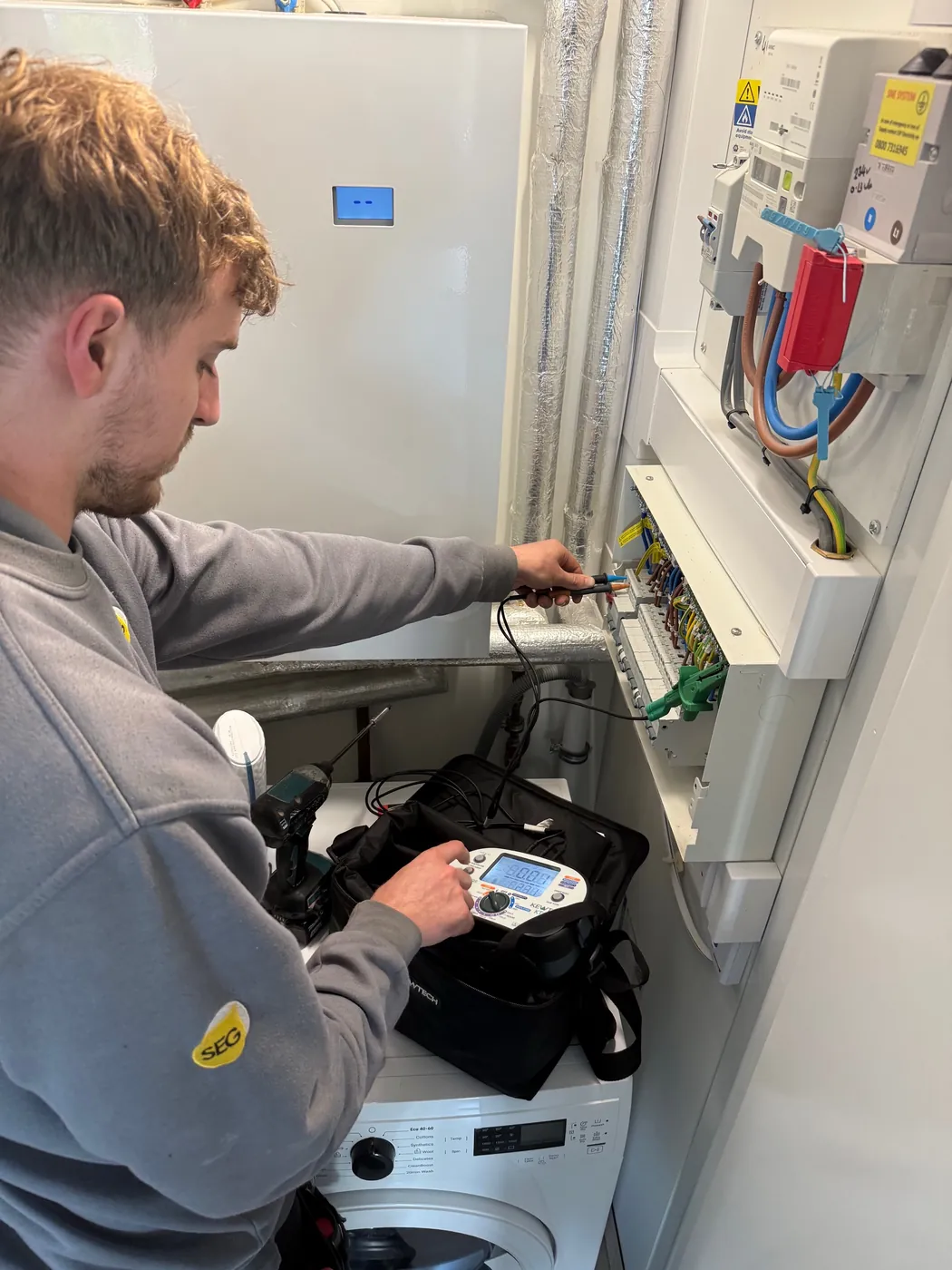
An EICR is an inspection and test of the whole fixed installation against BS 7671, the IET Wiring Regulations. Our engineer:
- checks the consumer unit, the earthing and the main bonding to gas and water pipes;
- tests every circuit: insulation, continuity, polarity and earth fault loop impedance;
- tests the RCDs that protect you from electric shock;
- samples sockets, switches and light fittings for damage, wear and overheating;
- records anything that falls short of current safety standards, coded C1 (danger present), C2 (potentially dangerous), C3 (improvement recommended) or FI (further investigation).
You get a written report. A C1 or C2 means the installation is “unsatisfactory” until it is put right. C3s are recommendations, not failures. See what the results mean.
What it costs with SEGplc
| Property | Homeowner price (inc VAT) | Typical time |
|---|---|---|
| Studio or 1-bed flat | £156 | Around 2 hours |
| 2-bed flat or house | £186 | 2 to 3 hours |
| 3-bed house | £216 | 3 to 4 hours |
| 4-bed house | £258 | Half a day or more |
| 5+ bed or large house | from £318 | Most of a day |
Includes up to 10 circuits on one consumer unit. Extra circuits £30 each; an extra fuse board £48 plus £30 for each circuit on it. Subject to survey; we confirm the price before booking. Any remedial work is quoted separately.
If the report finds anything that needs doing, you get a fixed price for it with the report, so you can decide straight away. See EICRs in St Albans and how much an EICR costs.
Questions about selling and electrical certificates
Is an EICR a legal requirement when selling a house?
No. In England you do not need an EICR to sell a home you live in. The Law Society’s property information form (TA6) does ask whether you have one, and asks for certificates for electrical work done on the house, so it helps to have the paperwork ready.
What is an electrical safety certificate?
People use the phrase for two different documents. An Electrical Installation Condition Report (EICR) is a report on the condition of the whole installation. An Electrical Installation Certificate, or a Building Regulations Compliance Certificate, covers a specific job such as a new consumer unit or rewire. When you sell, the buyer’s solicitor may ask for either.
What if I can’t find the certificates for work done on my house?
Ask the electrician who did the work first. If they were in a competent person scheme, the scheme or your council’s building control team may be able to supply a copy. If the paperwork can’t be found, tell your solicitor: an EICR shows the installation’s condition now, and your solicitor can advise on the options.
How long does an EICR take?
Around two hours for a 1-bed flat and three to four hours for a typical 3-bed house. The power is off for parts of the visit.
I’m selling a rented property. What do I need?
Private and social landlords in England must have a satisfactory EICR at least every five years. If the sale includes a tenancy, the buyer will expect to see the current report. See electricians for landlords.
Should I get an EICR when I buy a house?
Electrical Safety First recommends an inspection before buying a previously occupied property. It tells you what you are taking on, and gives you facts to negotiate with.
Sources
- Electrical Safety First, Is an EICR a legal requirement to sell my house?
- Electrical Safety First, Periodic inspection and testing explained
- The Law Society, TA6 (6th edition) explanatory notes for sellers and buyers
Written by SEGplc, NICEIC-approved electrical contractors in St Albans. Last updated 26 October 2026. This is general guidance, not legal advice.
Need it done by a date?
Tell us the deadline. We’ll tell you honestly whether we can hit it — and we usually can.