

- Home
- What is an RCBO?
What is an RCBO?
One switch in the fuse board that does two jobs for one circuit. How it differs from an MCB and an RCD, what Type A and Type AC mean, and when it matters to you.
The short answer
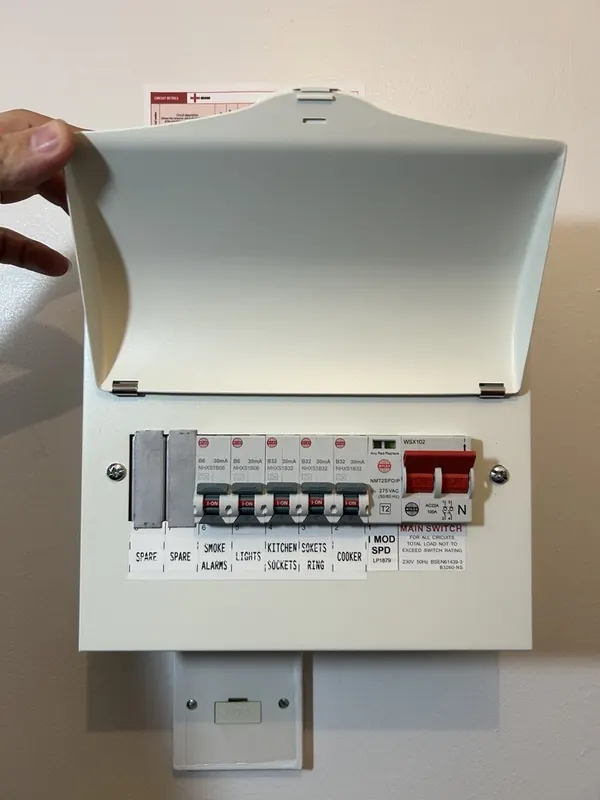
An RCBO is one switch in your fuse board that protects one circuit against two things: too much current, and current leaking to earth, which is what happens in an electric shock. It does the job of a circuit breaker (MCB) and an RCD in a single device, so when something goes wrong only that circuit switches off.
The letters stand for residual current circuit breaker with overcurrent protection. On the board it looks like an ordinary narrow breaker with a small test button of its own.
RCBO, MCB and RCD: the difference
| Device | What makes it switch off | What it covers | When it trips |
|---|---|---|---|
| MCB (circuit breaker) | Too much current: an overload or a short circuit. It stops the cable overheating. | One circuit. | That circuit goes off. An MCB does not react to a small leak of current to earth. |
| RCD | Current leaking to earth, for example through a damp fitting, a faulty appliance or a person. In homes it is normally rated 30mA. | Usually a group of circuits, sometimes the whole board. | Every circuit it covers goes off. An RCD on its own does not react to an overload. |
| RCBO | Both of the above. | One circuit. | Only that circuit goes off. |
Not sure which of these you have? What kind of board do you have? shows how to tell from the front of the board. If something has tripped and will not reset, see RCD keeps tripping? for the checks you can safely do yourself.
Why an RCBO on every circuit matters
Many older boards are “split-load”: one or two RCDs, each shared by a group of circuits. A leak to earth on any one of those circuits trips the shared RCD, and every circuit on that side of the board goes off with it. That is why a faulty kettle can take out the freezer, the wifi and half the lights.
On a board with an RCBO on every circuit, each circuit has its own protection. One fault trips one circuit. The rest of the house stays on, and the switch that is down tells you which circuit has the problem, so the fault is quicker to find.
There is a second benefit. Computers, TVs, chargers and LED lights each leak a tiny current to earth in normal use. On a shared RCD those small leaks add up, and they can trip it when nothing is actually wrong. The Wiring Regulations say the normal leakage on any one RCD should be no more than 30% of its rating (BS 7671, regulation 531.3.2), and ask the designer to consider RCBOs in place of a split-load board for that reason. Spread across separate RCBOs, the leakage on each one stays low.
Type A and Type AC
RCBOs and RCDs also come in types, which describe the kind of leaking current they can detect. Type AC detects ordinary alternating current only. Type A detects that and also pulsating direct current, which modern electronics can produce when they develop a fault. Washing machines, dishwashers, tumble dryers and LED lighting are among the examples the IET gives. That kind of current can stop a Type AC device tripping when it should. Since the 2022 amendment the Wiring Regulations have allowed Type AC only for fixed equipment that is known to produce no direct current, so new work in a home is normally done with Type A. An existing Type AC device is not illegal: on an EICR it is normally a C3, improvement recommended. One thing that confuses people: the letter in front of the amps is not the type. “B32” means a 32 amp breaker with a B trip curve, not a Type B RCD.
When it matters to you
- A new fuse board. A consumer unit with an RCBO on every circuit is what we normally fit in homes now. See fuse board replacement for what is included and how to book, and does my fuse board need replacing? if you are not sure yours needs changing. Most new boards also get a surge protection device.
- An EICR. An older Type AC RCD is normally recorded as a C3, which does not fail the report, although some inspectors code it higher. In 101 of our own home EICRs, five homes had Type AC RCDs, and in four flats they were coded C2. No RCD protection at all is a different matter: it is a C2 or a C3 depending on what the circuit supplies. A split-load board in good condition is not a defect. See EICR codes explained.
- Tripping that keeps coming back. RCBOs do not cure a fault. They confine it to one circuit and show you which one. Most tripping is caused by an appliance or a fault on a single circuit, so find that first: see RCD keeps tripping? and find which appliance is tripping the electrics.
- A new circuit. An EV charger, for example, gets its own circuit and its own RCBO. In Letchworth we fitted a 32 amp Type A RCBO in a spare way of the existing board for a zappi charger: see the job.
One of our jobs: Radlett, November 2025
A family home had an old Wylex split-load board with a single 30mA RCD, and several circuits had no RCD protection at all. We replaced it with a new board with a 30mA RCBO on every circuit and surge protection. Testing the new board showed up faults the old one had been hiding, which we traced and put right over the two days on site. See the job.
Sources
- IET Wiring Matters, September 2019, Which RCD type?
- Hager, An overview of 18th Edition Amendment 2 (RCD selection and unwanted tripping)
- Electrical Safety First, Best Practice Guide 4, Issue 7.4 (August 2026)
- SEGplc job records and What we found in 101 home electrical inspections
Questions we’re asked
What does RCBO stand for?
Residual current circuit breaker with overcurrent protection. It is a circuit breaker and an RCD in one device, protecting a single circuit.
What is the difference between an RCBO and an RCD?
An RCD detects current leaking to earth and usually covers a group of circuits, so one fault switches all of them off. It does not protect against overload. An RCBO detects leakage and overload, and covers one circuit only, so a fault switches off just that circuit.
What is the difference between an RCBO and an MCB?
An MCB switches off when there is too much current: an overload or a short circuit. An RCBO does that and also switches off when current leaks to earth. They look alike, but an RCBO has a test button.
Is an RCBO board better than a board with two RCDs?
Both give the same 30mA protection against electric shock. The difference is what happens when something trips: with RCBOs one fault switches off one circuit, and the small leaks from modern electronics are spread out, so there are fewer unwanted trips. An RCBO board costs more because there is a device for every circuit.
Why does my RCBO keep tripping?
It has detected an overload, a short circuit or a leak to earth on that circuit. Unplug everything on the circuit and reset it once. If it trips again with nothing plugged in, the fault is in the fixed wiring or a fitting and needs an electrician. Do not keep forcing it back on.
Can RCBOs be added to my existing fuse board?
Sometimes. It depends on the make and age of the board and whether there is room, so we need to see it. In Letchworth we fitted a 32 amp Type A RCBO in a spare way of an existing board for an EV charger. If the board is old or full, a new board is usually the better answer.
Do I need to test an RCBO?
Yes, the same as an RCD. Press the test button every six months. It should switch off straight away. Switch it back on afterwards. If it does not switch off, call an electrician.
Written by SEGplc. Last updated 15 November 2026.
Need it done by a date?
Tell us the deadline. We’ll tell you honestly whether we can hit it — and we usually can.