

- Home
- RCD keeps tripping
RCD keeps tripping? What to check, and when to call us.
Why your electrics keep tripping, the safe checks you can do in five minutes, and how our engineers find the faults you cannot.
First, what has tripped?
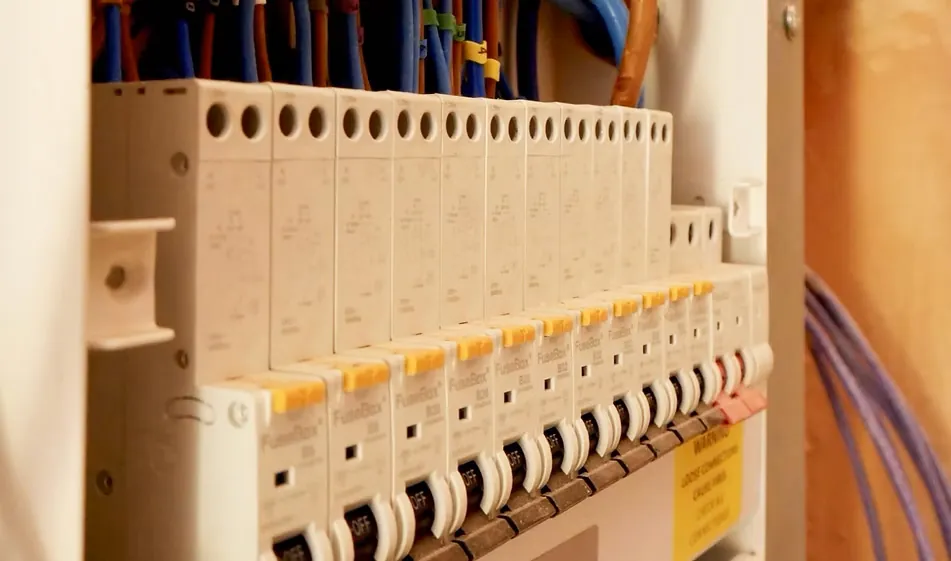
Open the fuse board (consumer unit) door and look for the switch that is down. They do different jobs, so it tells you a lot.
| Device | How to spot it | What makes it trip |
|---|---|---|
| RCD | Wider switch with a T or Test button, usually marked 30mA. Often covers several circuits. | Current leaking to earth: a faulty appliance, water, or damaged cable. Switches off every circuit it covers. |
| MCB (circuit breaker) | Narrow switch marked with a letter and number, such as B6 or B32. | Too much current on one circuit (overload) or a short circuit. Switches off just that circuit. |
| RCBO | Narrow switch with its own small test button. One per circuit on modern boards. | Both of the above, but only for its own circuit, so one fault does not take out half the house. |
| Fuse | Older boards with pull-out fuse carriers instead of switches. | Overload or short circuit. Older fuse boards often have no RCD protection at all; see fuse board replacement. |
Safe checks you can do yourself
These steps only use the switches on the front of the board and the plugs on your appliances. Never take the cover off the board, a socket or a light fitting.
- Note what happened. What was switched on, what time it was, whether it was raining. It is often the best clue.
- Try to reset it once. If it switches straight off again, do not keep forcing it.
- Unplug everything on the circuits that went off, and switch off fixed appliances such as the oven, shower and immersion heater at their switches.
- Find the circuit. If an RCD has tripped, switch off all the circuit breakers it covers, reset the RCD, then switch the breakers back on one at a time. The one that makes it trip again is the circuit with the problem. Leave that one off.
- Find the appliance. If everything stays on with the appliances unplugged, plug them back in one at a time. If one trips it, keep it unplugged and have it repaired or replaced.
- Stop there. If a circuit trips with nothing plugged in, the fault is in the fixed wiring or a fitting, and it is a job for an electrician.
The most common causes
- A faulty appliance. Kettles, washing machines, dishwashers, tumble dryers, oven and immersion heater elements, and old fridges and freezers are frequent culprits.
- Water or damp. Outside lights and sockets, garden buildings, bathroom fans, and junction boxes in damp lofts or under leaking pipes.
- Damaged cable. A nail or screw through a cable in a wall or floor, often after shelves, flooring or a kitchen are fitted, or cables chewed by rodents.
- A neutral-to-earth fault. A wiring fault that can trip the RCD when something on a different circuit is switched on, which makes it confusing to trace.
- Too much on one RCD. Computers, TVs, chargers and LED lighting each leak a tiny current to earth. On a board where one RCD covers half the house, it adds up. The Wiring Regulations (BS 7671, regulation 531.3.2) say the total on an RCD should not exceed 30% of its rating, which is 9mA on a 30mA RCD.
- A worn or faulty RCD. RCDs can become over-sensitive with age, or fail to trip at all, which is worse.
- New equipment. An EV charger, heat pump, hot tub or garden office added to an old board without checking it can cope.
If it is a circuit breaker (MCB) rather than an RCD, the usual causes are too many high-power appliances on one circuit at once, such as a kettle, heater and tumble dryer on the same ring, or a short circuit in an appliance or fitting.
Tripping at night, or when it rains
At night: look for anything on a timer or sensor. Immersion heaters on Economy 7, storage heaters, freezer defrost cycles, outside lights on a sensor and EV chargers set to charge overnight are the usual suspects.
When it rains: water is getting in somewhere. Check outside lights and sockets for cracked covers or water inside, and whether the garden office or shed supply goes off with the rest. Leave that circuit off and call us; this is not a fault that fixes itself.
When to call an electrician
- A circuit trips with nothing plugged in.
- The RCD will not reset at all.
- It trips more than once in a short time and you cannot find the cause.
- There is any burning smell, scorching, buzzing or a hot socket or switch.
- The RCD does not switch off when you press its test button.
- You are a landlord or letting agent and a tenant reports tripping. You have a legal duty to keep the installation safe; see electricians for landlords.
How we find the fault
Our engineers are employed, NICEIC-approved electricians with proper test equipment, not guesswork. On a fault-finding visit we:
- Ask what happened, when, and what was running.
- Test the RCD’s trip current and trip time to see whether the device itself is at fault.
- Measure the earth leakage on each circuit with a leakage clamp meter.
- Carry out insulation resistance tests to find damaged cables and failing fittings or appliances.
- Make it safe, explain what we found in plain English, and quote clearly before any repair.
If your board has one RCD covering half the house, we may suggest a new consumer unit with RCBOs, so a single fault only switches off one circuit and the freezer stays on. If tripping points to deeper problems, an EICR checks the whole installation, and old or damaged wiring may need a partial or full rewire.
Test your RCD every six months
The current Wiring Regulations, BS 7671:2018+A4:2026, advise testing RCDs every six months. Press the button marked T or Test on each RCD. It should switch off straight away; switch it back on and reset any clocks. If it does not switch off, call an electrician.
Tripping electrics: questions we’re asked
Is it dangerous if my RCD keeps tripping?
The RCD tripping is the safety device doing its job: it has detected electricity leaking to earth, which is what happens in an electric shock. The leak itself needs finding. Never tape, wedge or bypass an RCD to keep the power on.
Why does my RCD trip at night?
Usually something that switches itself on: an immersion heater on an Economy 7 timer, a freezer’s defrost cycle, storage heaters, outside lights on a sensor, or an EV charger set to charge overnight. Note the time it trips and what is on a timer; it is often the quickest clue.
Why does my electricity trip when it rains?
Water is getting into something outside or in the roof space: an outside socket or light, a garden office supply, a junction box in a damp loft, or a damaged cable. It needs an electrician to find and seal or replace the part, because the fault will come back with the next downpour.
Can an RCD trip for no reason?
There is almost always a reason, but it is not always a single fault. Lots of modern electronics each leak a tiny current to earth, and on a board where one RCD covers half the house those leaks add up. RCDs can also become over-sensitive with age. We test the RCD’s trip current and time, and measure the leakage on each circuit, to tell which it is.
Do I need a new fuse board if it keeps tripping?
Not necessarily. Most tripping is caused by an appliance or a fault on one circuit, and fixing that stops it. But if one RCD covers half the house, if the board is old, or if the RCD itself is faulty, an upgrade to a board with an RCBO on every circuit means one fault only switches off one circuit.
How long does electrical fault finding take?
With the right test equipment most faults are found on the first visit. Intermittent faults that only happen at certain times can take longer. We tell you what we have found and what the repair will cost before we carry on.
How often should I test my RCD?
Every six months: press the button marked T or Test on the RCD. It should switch off straight away. Switch it back on. If it does not switch off, call an electrician, because it may not protect you when it matters.
Sources
- Test-Meter, BS 7671 regulation 531.3.2, unwanted RCD tripping
- iCertifi, BS 7671 Amendment 4 (2026): six-monthly RCD testing guidance
Written by SEG. Last updated 11 October 2026.
Need it done by a date?
Tell us the deadline. We’ll tell you honestly whether we can hit it — and we usually can.