

- Home
- Does my fuse board need replacing?
Does my fuse board need replacing?
The warning signs, how to tell what kind of board you have, other reasons to upgrade, and what a new consumer unit costs, from £399 including VAT.
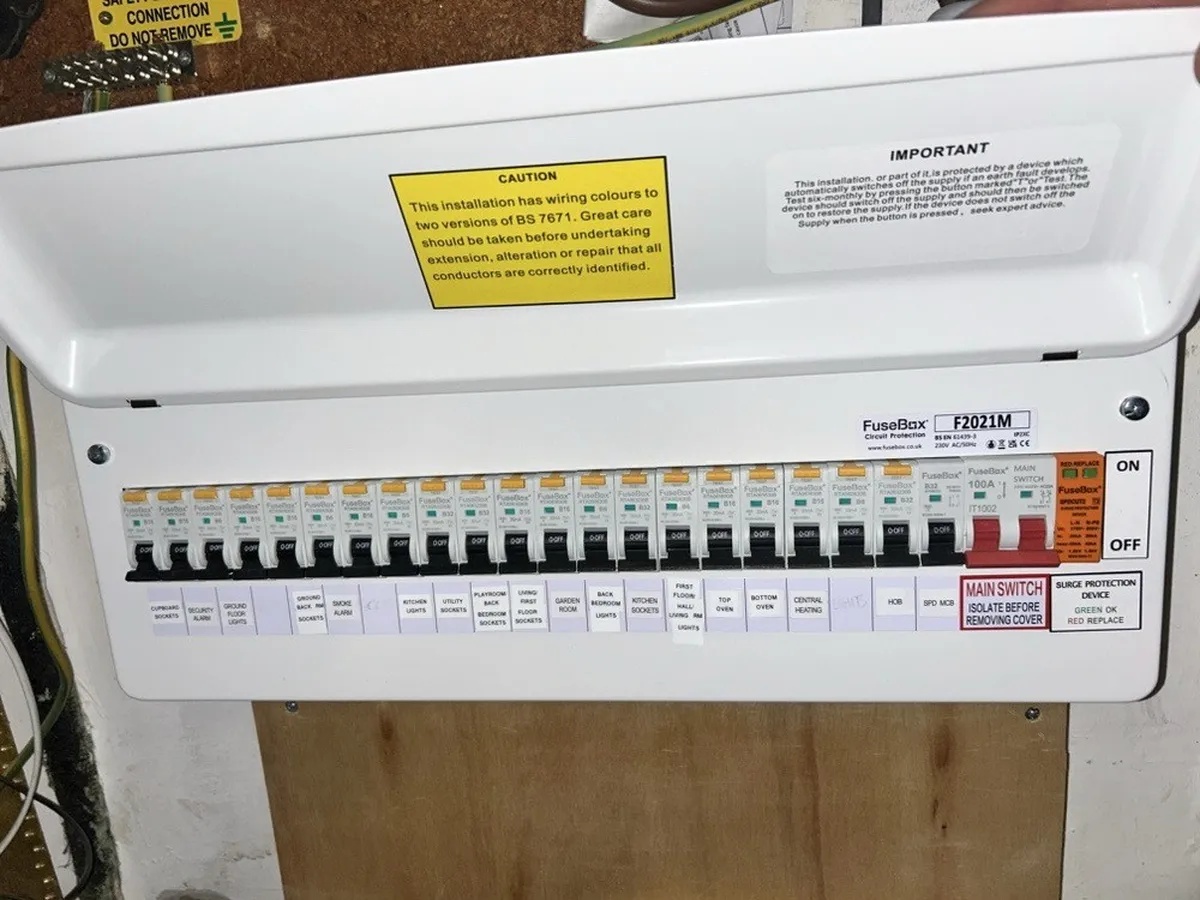
Your fuse board, or consumer unit, is where the electricity coming into your home is split into circuits and protected. Many homes still have boards from the 1970s, 80s or 90s that give little or no protection against electric shock. Not every old board needs replacing, but some do. Here is how to tell, and what a new one costs with SEGplc.
Signs your fuse board needs replacing
- Pull-out fuses with fuse wire (rewireable fuses), or a mix of old fuses and circuit breakers.
- No RCD. An RCD is the switch with a T or Test button. It cuts the power in a fraction of a second if someone touches something live. No RCD usually means an older board.
- A wooden backboard, or several separate boxes added over the years.
- Scorch marks, a burning smell, crackling or buzzing, or a board that feels warm. Call us the same day.
- Trips you can’t trace, or one RCD that takes out half the house every time something faults. See RCD keeps tripping?
- Cracked, loose or damaged covers, or a board that won’t close.
- An EICR that recorded the board as a problem, for example a C2 for missing RCD protection.
What kind of board do you have?
| What you see | What it is | Usually means |
|---|---|---|
| Pull-out fuses, often on a wooden board | Rewireable fuse box | No RCD protection; replacement recommended |
| Switches, but no Test button anywhere | Circuit breakers without RCD | No shock protection; replacement recommended |
| One or two RCDs, each covering several circuits | Split-load consumer unit | Fine if in good condition; one fault can switch off half the house |
| A small switch with a test button on every circuit | RCBO board | Modern; a fault only switches off its own circuit |
| Plastic case | Pre-2016 consumer unit | Not illegal; replace if damaged, overheating or full |
A metal consumer unit with RCBOs is what we normally fit in homes now. Each circuit has its own protection, so a faulty kettle no longer plunges half the house into darkness, and the freezer stays on. Most homes also get surge protection, which the current Wiring Regulations normally call for, and arc fault detection (AFDDs) where required, for example in HMOs.
Other reasons to upgrade
- An EV charger, which needs its own circuit and suitable protection. See EV chargers.
- Solar panels, a battery or a heat pump. See solar PV.
- An extension, loft conversion, new kitchen or garden office, adding circuits the old board can’t take.
- A rewire. A new board is part of every full rewire; see does my house need rewiring?
- Selling or letting, where an EICR has flagged the board.
How much does a new fuse board cost?
A new consumer unit with SEGplc starts from £399 including VAT for a small 2-way board, for example for a garage, outbuilding or very small flat. That covers the board, fitting, testing, your Electrical Installation Certificate and Building Regulations notification.
What affects the price for a whole house:
- The number of circuits, and so the size of the board.
- RCBOs on every circuit instead of shared RCDs.
- Surge protection and any arc fault detection.
- Upgrading the main earth or the bonding to gas and water pipes, if they are not up to standard.
- Faults found when we test the existing circuits. A modern board won’t stay on with a serious fault on a circuit, so these have to be put right first. We tell you and quote before doing them.
- Moving the board to a new position.
We give a fixed written price after looking at your board. The quickest way is to send us a photo of it.
What happens on the day
- Test first. We test the existing circuits so any faults are found and explained before anything changes.
- Power off. The power is off for much of the day. Tell us about anything that must stay on, such as medical equipment.
- Fit and connect the new board, upgrade the earthing and bonding if needed, and label every circuit.
- Test and certify every circuit. You get an Electrical Installation Certificate, and we notify Building Control, which sends you a compliance certificate.
More detail on what we fit is on our fuse board replacement page. Not sure whether your board needs changing? An EICR checks the whole installation, from £156 including VAT for a 1-bed flat; see EICR prices.
Fuse board questions we’re asked
How do I know if my fuse box needs replacing?
The main signs are pull-out fuses with fuse wire, no RCD protection, a wooden backboard or a mix of old boxes, a plastic consumer unit, scorch marks, buzzing or a burning smell, and trips you can’t trace. Adding an EV charger, solar panels, a heat pump, an extension or a new kitchen is also a common reason. An EICR tells you for certain.
How much does a new fuse board cost?
With SEGplc, a new consumer unit starts from £399 including VAT for a small 2-way board. Most homes need a bigger board, and the price depends on the number of circuits, the type of protection (RCDs or RCBOs), surge protection, and whether the earthing and bonding need upgrading. We give a fixed written price after looking at your board.
Is a fuse box the same as a consumer unit?
People use the names for the same thing: the box where the electricity is split into circuits. Strictly, a fuse box has pull-out fuses, and a consumer unit has switches (circuit breakers) and usually RCDs. Old fuse boxes have no RCD protection, which is the main safety reason to upgrade.
Is it illegal to have an old fuse box?
No. There is no law that makes homeowners replace an old fuse box. But it may give no protection against electric shock, and an EICR will usually record that as a defect. For landlords, an unsatisfactory EICR must be put right within 28 days, and that often means a new board.
Do plastic consumer units need replacing?
Not automatically. Since 2016 the Wiring Regulations have required new consumer units in homes to be metal (non-combustible), but existing plastic boards are not illegal. If yours is plastic and in good condition, an EICR will usually note it as an improvement rather than a danger. We replace it if it is damaged, overheating or too small.
How long does it take to replace a consumer unit?
Most take most of a day, with the power off for much of it. A small board can be quicker; a large board, or one where earthing and bonding need upgrading, takes longer. We tell you roughly how long before we start.
Can I replace a consumer unit myself?
No, not safely or legally. Replacing a consumer unit is notifiable work under Part P of the Building Regulations in England, so it must be done by a registered electrician who certifies and notifies it, or signed off by Building Control.
Do I need a new fuse board for an EV charger?
Often, but not always. An EV charger needs its own circuit and suitable protection. If your board has no spare way, no suitable RCD protection or is old, a new board or a small extra board may be needed. We check this when we survey for the charger.
Prices include VAT and are subject to survey. Written by SEGplc. Last updated 19 October 2026.
Need it done by a date?
Tell us the deadline. We’ll tell you honestly whether we can hit it — and we usually can.