

- Home
- EICR codes explained
EICR codes explained: C1, C2, C3 and FI.
What each code on your electrical report means, which ones make it Unsatisfactory, and what to do if yours has failed.
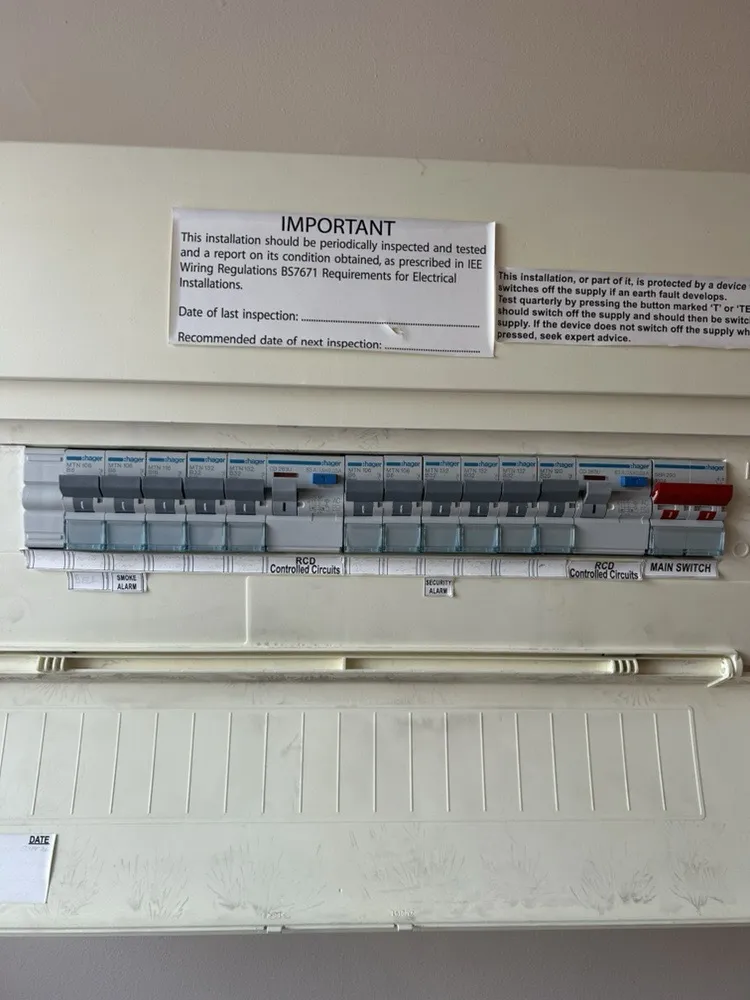
The four codes on an EICR
Every problem an electrician records on an Electrical Installation Condition Report (EICR) is given a code. The code tells you how serious it is and whether you have to act.
| Code | In plain English | What to do |
|---|---|---|
| C1 Danger present | Someone could be hurt now, for example a live part that can be touched. | Made safe straight away. You are told at once and in writing. |
| C2 Potentially dangerous | Not dangerous this minute, but it would be if a fault happened. | Have it fixed promptly. Landlords: within 28 days. |
| C3 Improvement recommended | Safe to use, but below today’s standard. | Nothing required. Worth doing when other work is being done. |
| FI Further investigation | The electrician could not tell whether there is a danger without more work. | Have it looked into. Landlords must where the report requires it. |
Which codes make a report Unsatisfactory?
Any C1 or C2 makes the report Unsatisfactory. A report with only C3s is Satisfactory: C3 is advice, not a fail.
FI is the one that is changing. Under the guidance most reports have been written to, an FI also makes the report Unsatisfactory where the investigation is needed to decide whether there is a danger. The 2026 amendment to the wiring regulations (BS 7671:2018+A4:2026) changes the wording to “further investigation is advised”, and the IET says a C3 or FI on its own no longer gives an Unsatisfactory result. Reports written before the change, and many landlord and housing specifications, still treat FI as Unsatisfactory. Check the result written on your own report, and ask the electrician which edition it was written to.
Examples of each code
These come from Electrical Safety First’s Best Practice Guide 4, a guide widely used by electricians for coding homes, and from our own reports. The same item can be coded differently depending on where it is and what it supplies, so the code is always the inspector’s judgement on the day.
C1: danger present
- Live wires with missing or damaged insulation that can be touched.
- A badly broken socket, switch or fitting with live parts exposed.
- A gap in the fuse board where a breaker is missing and nothing covers the hole.
- Metal parts that have become live because of a fault.
C1s are rare. In 101 of our own home EICRs, none had one.
C2: potentially dangerous
- No reliable earth, or no earth at a socket.
- No main bonding to the gas or water pipes where it is needed. We found this in 2 of our 101 homes.
- No RCD protection for a socket likely to be used for equipment outdoors, or for a socket circuit in a bathroom.
- A ring circuit with a break in it. In St Albans in 2026 we found an open circuit in a ring that could not be seen from any socket.
- A metal light fitting or metal switch plate on a lighting circuit that has no earth wire.
C3: improvement recommended
- No RCD protection for sockets that are unlikely to be used outdoors, for lighting circuits, or for cables buried less than 50 mm deep in a wall.
- An older Type AC RCD where a Type A is now required. See Type A and Type AC explained.
- No surge protection device where today’s regulations call for one.
- A plastic fuse board under a wooden staircase or in the only escape route.
- A lighting circuit with no earth wire where every fitting and switch is plastic.
- Circuits not labelled at the fuse board.
FI: further investigation
The guide gives no standard examples for homes, because an FI depends on what could not be confirmed. In our reports a typical one is a high reading on a socket circuit that points to a loose connection somewhere: it needs tracing before anyone can say whether it is dangerous. An FI should not be used just because something would be nice to know.
Not coded at all
- Old wiring colours (red and black). They met the rules when they were installed and do not need recording.
- No smoke alarms. Noted as an observation, without a code.
- A plastic fuse board anywhere else than under wooden stairs or in the only escape route.
- No arc fault detection in an ordinary house or flat. Noted, not coded.
The items we are asked about most
- “No surge protection”. C3 at most. It does not fail the report. See surge protection devices explained.
- “Plastic consumer unit”. C3 if it is under a wooden staircase or in the only way out; otherwise not coded. On its own it does not fail the report. See does my fuse board need replacing?
- “Type AC RCD”. C3 in the guide. Some inspectors code it higher where they judge it would not protect the equipment on that circuit. If yours is a C2, ask why.
- “No earth on the lighting circuit”. C3 while every fitting and switch is plastic; C2 once there is a metal one.
- “Smoke alarms”. Not a pass or fail item on the EICR, although landlords have separate alarm duties. See fire alarm grades.
My EICR is Unsatisfactory: what now?
- Read the observations page. Each item has a code and a location. Only the C1, C2 and FI items need action.
- Check any C1 was made safe. The electrician should have dealt with it on the day or told you to switch that circuit off.
- Get the work priced item by item. You do not have to use the firm that did the test. Send us the report and we will price each coded item separately: see EICR remedial works.
- Question a code if it looks harsh. Coding involves judgement, and a second electrician may reasonably disagree with a C2.
- Keep the paperwork together. After the work you get written confirmation that it is done, such as an Electrical Installation Certificate or a Minor Works certificate. That sits with the original report. You do not need a second full EICR.
An Unsatisfactory result is not unusual: 9 of the 101 homes we tested had one. Most of the items we see are a few hours’ work.
How long do you have to fix it?
- Landlords in England: 28 days from the inspection, or sooner if the report says so, for anything the report requires. Then give the written confirmation and the report to the tenant and the council within 28 days of the work. More in how long does an EICR last?
- Homeowners: no legal deadline. A C1 should already be safe; a C2 is worth doing promptly because it is the fault that turns into a danger.
- Buying or selling: the report is evidence either side can use. See an EICR before buying a house and do I need an EICR to sell?
Sources
- Electrical Safety First, Best Practice Guide 4, Issue 7.2: Electrical installation condition reporting (March 2025)
- IET Wiring Matters, July 2026, Further Investigation
- legislation.gov.uk, Electrical Safety Standards in the Private Rented Sector and Social Rented Sector (England) Regulations 2020, regulation 3
- SEGplc, What we found in 101 home electrical inspections
Questions we’re asked
What do the codes on an EICR mean?
C1 means danger present. C2 means potentially dangerous. C3 means improvement recommended. FI means further investigation. Any C1 or C2 makes the report Unsatisfactory; C3s on their own do not.
Is a C3 a fail?
No. C3 means the installation is safe to use but below today's standard. A report with only C3s is Satisfactory and no work is required.
Does FI fail an EICR?
On most reports so far, yes, where the investigation is needed to decide whether there is a danger. The 2026 amendment to the wiring regulations changes FI to advice that no longer fails the report on its own. Check the result on your own report.
How long do I have to fix a C2?
Landlords in England have 28 days from the inspection, or less if the report says so. Homeowners have no legal deadline, but a C2 is a potential danger and should be fixed promptly.
Is a plastic consumer unit a C2?
No. Under the Electrical Safety First guide it is a C3 only if it is under a wooden staircase or in the only escape route, and it is not coded at all elsewhere.
What code is no surge protection on an EICR?
C3 at most, where today's regulations call for a surge protection device. It does not make the report Unsatisfactory.
Can I get a second opinion on an EICR code?
Yes. Coding involves judgement and you can take the report to another electrician. We price each coded item separately and say so if we think an item has been over-coded.
Do I need a new EICR after the remedial work?
No. You need written confirmation that the work is done, such as an Electrical Installation Certificate or a Minor Works certificate, kept with the original report.
Written by SEGplc. Last updated 13 November 2026.
Need it done by a date?
Tell us the deadline. We’ll tell you honestly whether we can hit it — and we usually can.