

- Home
- Surge protection device
What is a surge protection device (SPD)?
What a surge protection device (SPD) does, what the Wiring Regulations require in a home and what is your choice, and what an EICR says if your fuse board has none.
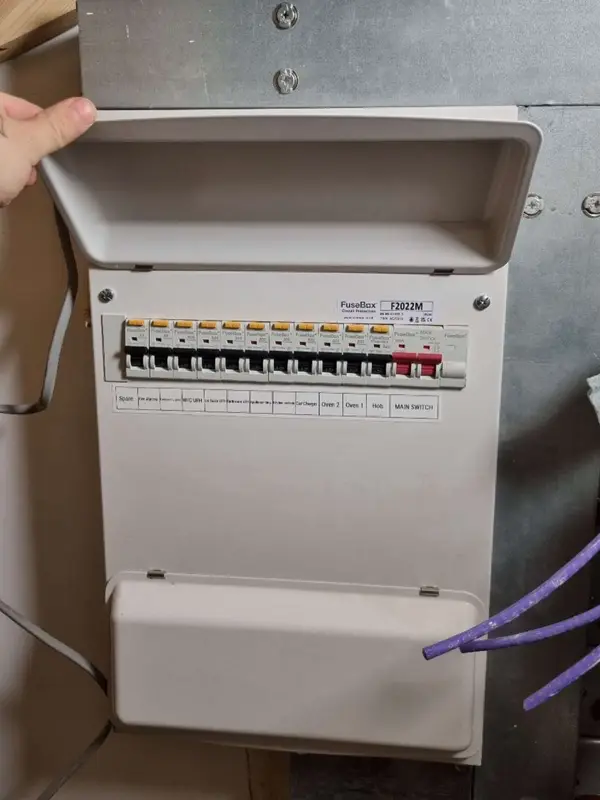
The short answer
A surge protection device (SPD) is fitted at the fuse board and protects the wiring, and everything connected to it, from very short spikes in voltage caused by lightning nearby or by electrical equipment switching. Under the current Wiring Regulations a new fuse board in a home is fitted with one unless the owner chooses to go without and accepts the risk.
It is not there to protect people from electric shock. That is the job of the RCDs or RCBOs in the same board.
What a surge protection device protects against
The spikes are called transient overvoltages. They last from millionths of a second to a few thousandths of a second, and they can be far above the normal mains voltage. There are two causes:
- Lightning. Usually not a strike on the house itself, but a strike on or near an overhead power or telephone line, which sends a surge along the cable.
- Switching. Motors, transformers and some types of lighting cause surges when they switch. The IET notes that EV chargers, heat pumps and speed-controlled washing machines make surges more likely in homes than they used to be.
A surge can kill a piece of electronics outright, or do damage that only shows later. The things at risk are the ones with electronics inside: TVs, computers, washing machines, microwaves, alarm systems and mains-wired smoke alarms. An SPD sits across the supply doing nothing until the voltage rises too high, then diverts the surge to earth.
What it does not do: it does not keep the power on in a power cut, it does not stop a circuit being overloaded, and it does not protect against electric shock.
What the Wiring Regulations say about homes
The Wiring Regulations (BS 7671, the 18th Edition) deal with this in regulation 443.4.1. The rule came in with the 2022 amendment and still applies under the current one, BS 7671:2018+A4:2026.
- Required, with no opt-out: where a surge could cause serious injury or loss of life, the failure of a safety service, or significant financial or data loss.
- Required unless the owner opts out: every other case, which covers most ordinary houses and flats. Surge protection must be provided unless the owner of the installation declares that it is not required, because any loss or damage would be tolerable to them and they accept the risk to their equipment.
So in a home, surge protection comes by default with new work such as a new fuse board or a rewire. Leaving it out is the owner’s choice, not the electrician’s, and the decision should be recorded.
BS 7671 is a British Standard for new work. It does not make anyone go back and add surge protection to a board that was fitted to an earlier edition.
| Situation | Surge protection |
|---|---|
| A new fuse board or a rewire in an ordinary home | Fitted by default. The owner can decline it and accept the risk. |
| Anywhere a surge could cause serious injury, stop a safety service working, or cause significant financial or data loss | Required. No opt-out. |
| An existing fuse board, with no other work planned | Your choice. Nothing in the regulations makes you add one. |
| An EICR on a home that has none | A C3 at most. It does not fail the report. |
Type 1, Type 2 and Type 3
| Type | Where it goes | What it is for |
|---|---|---|
| Type 1 | At the origin of the supply, in the main board. | Built to carry part of the current from a direct lightning strike. |
| Type 2 | In the fuse board or distribution board. | Surges from indirect lightning and from switching. This is the type built into home consumer units. |
| Type 3 | Close to sensitive equipment. | Local extra protection. Only ever a supplement to a Type 2, never a replacement for one. |
The new boards in our Radlett and St Albans jobs both have a Type 2 device.
Does an older fuse board need one added?
No. An existing board without surge protection is not illegal, and nothing in the regulations makes you add it. It is worth thinking about if:
- you have mains-wired smoke alarms, which a surge can knock out without anyone noticing;
- you have, or are adding, an EV charger, a heat pump, solar panels or a lot of home office equipment. myenergi, for example, says a separate surge protection device must be fitted with its zappi charger;
- your electricity or phone line arrives overhead.
The IET says surge protection can be fitted in an existing consumer unit where there is the physical space for it. Whether yours can take one depends on the make, the age and what is already in it, so we need to see the board. If the board is old, full or has no RCD protection, it usually makes more sense to deal with the board as a whole: see does my fuse board need replacing? and fuse board replacement.
What an EICR says about a missing one
A C3 at most: improvement recommended. It does not make the report Unsatisfactory, and a landlord is not required to act on a C3. That is the coding in Electrical Safety First’s Best Practice Guide 4, a guide widely used by electricians for coding homes. In 101 of our own home EICRs, six homes were given a C3 for mains smoke alarms with no surge protection. A C3 on its own cannot fail a report. See EICR codes explained for what each code means and which ones you have to act on.
How to tell if yours is working
Most surge protection devices have a small indicator window on the front. Green means it is working. Red means it has reached the end of its life and needs replacing, which is often a plug-in cartridge an electrician can swap. It is worth a glance now and then, and after a thunderstorm.
Sources
- IET Wiring Matters, November 2023, Surge Protective Devices (SPDs) (regulation 443.4.1)
- IET, Surge protective devices
- Electrical Safety First, Best Practice Guide 4, Issue 7.4 (August 2026)
- BEAMA, Guide to Surge Protection Devices
- Hager, Surge protection (types, duration and the indicator window)
- SEGplc job records and What we found in 101 home electrical inspections
Questions we’re asked
What is a surge protection device?
A device fitted at the fuse board that protects the wiring and the equipment connected to it from very short spikes in voltage, caused by lightning nearby or by switching. When the voltage rises too high it diverts the surge to earth. It is often shortened to SPD.
Is surge protection a legal requirement in a house?
It is a requirement of the Wiring Regulations, BS 7671, for new work, not a law that applies to every existing home. With a new fuse board or a rewire in an ordinary home it must be fitted unless the owner declares it is not required and accepts the risk of damage. Nothing makes you add one to an existing board.
Can I say no to surge protection on a new fuse board?
In an ordinary home, yes. The regulations let the owner of the installation declare that it is not required, accepting the risk of damage to equipment and any loss that follows. There is no opt-out where a surge could cause serious injury, stop a safety service working, or cause significant financial or data loss.
Does my old fuse board need surge protection adding?
No. An existing board without it is not illegal. It is worth considering if you have mains-wired smoke alarms, an EV charger, a heat pump, solar panels or an overhead supply. It can sometimes be fitted in the existing board if there is space.
Does no surge protection fail an EICR?
No. It is recorded as a C3 at most, which means improvement recommended. A C3 does not make the report Unsatisfactory and a landlord is not required to act on it.
Is a surge-protected extension lead enough?
It only covers what is plugged into it. A device at the fuse board covers the fixed wiring and everything on it, including things that are not on a plug, such as the oven, mains smoke alarms and an EV charger.
How do I know if my surge protection device is working?
Most have a small indicator window on the front. Green means it is working. Red means it has reached the end of its life and needs replacing by an electrician.
Written by SEGplc. Last updated 15 November 2026.
Need it done by a date?
Tell us the deadline. We’ll tell you honestly whether we can hit it — and we usually can.