

- Home
- How long does an EICR last?
How long does an EICR last?
Up to five years for a rented home, up to ten for a home you live in, and never longer than the date written on the report. Here is how to check whether yours is still good.
Looking for how long the visit takes? See how long does an EICR take?
The short answer
An EICR lasts until the “next inspection” date written on it. For a rented home in England that date can be no more than five years away, by law. For a home you own and live in there is no legal limit; the usual recommendation is ten years. The electrician can set a shorter period if the wiring is old or in poor condition.
| Property | How long an EICR lasts | Law or advice? |
|---|---|---|
| Rented home in England (private or social) | Up to 5 years, or the earlier date on the report | Law |
| Home you own and live in | Up to 10 years recommended, or the date on the report | Advice (Electrical Safety First) |
| Business premises | The date recommended on the report for that type of building | No single legal interval: see fixed wire testing |
This page covers England. An Electrical Installation Condition Report (EICR) is the document people often mean by an electrical safety certificate or a landlord electrical certificate: see electrical safety certificates explained.
An EICR has a next-inspection date, not an expiry date
An EICR records the condition of the wiring on the day it was tested. It does not guarantee the next five or ten years. What it gives you is a recommendation: the date by which the installation should be inspected and tested again. You will find it in the Recommendations section near the front of the report.
The electrician chooses that date from the age and condition of the installation and how the building is used. A modern installation in a family home may be given ten years. An older one, or one with several improvements recommended, may be given five, three or even one. For a rented home the date cannot be more than five years away.
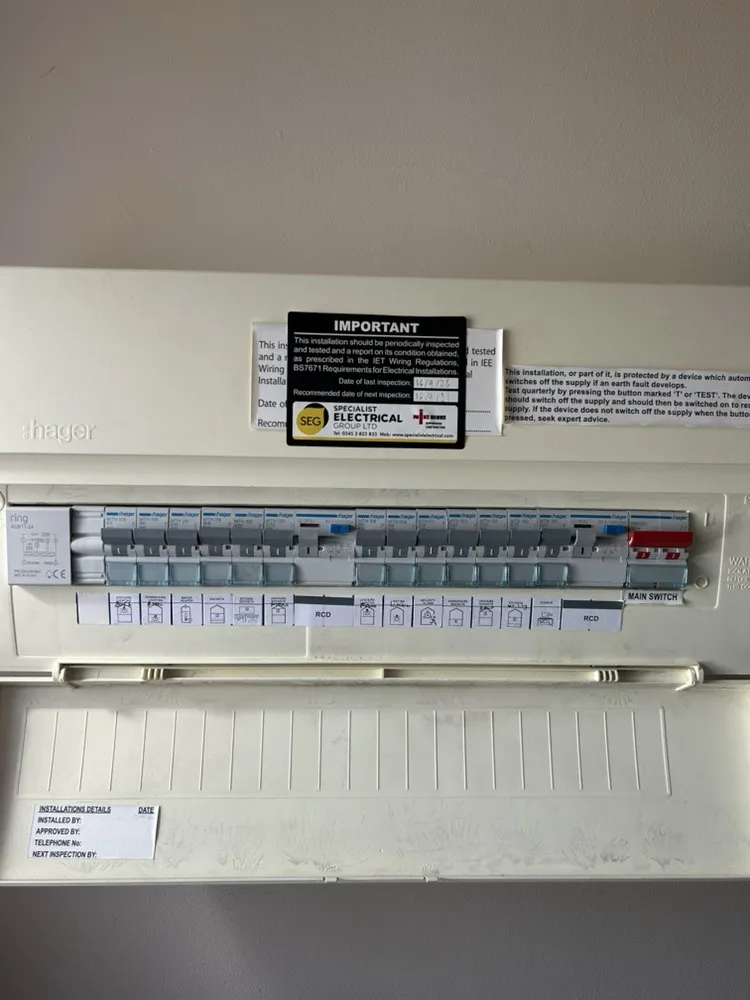
We also put a label on the fuse board with the date of the inspection and the recommended date of the next one, as in the photo on this page, so the next person does not have to hunt for the paperwork.
Is my EICR still valid? Six checks
- The next-inspection date has not passed. For a rented home, check too that it is no more than five years after the inspection date.
- The overall result is Satisfactory. An Unsatisfactory report is only good evidence together with written confirmation that the faults were put right. See EICR codes explained.
- The address is right, and the report covers the whole installation, not one circuit or one floor. Any limitations are listed on the report.
- It is signed, with the inspector’s name, firm and registration (NICEIC, NAPIT or similar). You can look the firm up on the scheme’s own register.
- It has a schedule of circuits and test results. A one-page “pass” sheet with no test results is not an EICR.
- Nothing major has changed since. A flood, a fire, damage, or a lot of new electrical work means the report no longer describes the installation you have.
If yours passes all six, it is valid and you do not need another yet. Not sure? Send us a photo of the first pages and we will tell you: contact us or call 01727 238 999.
Landlords: five years, and what the law asks for
The Electrical Safety Standards in the Private Rented Sector and Social Rented Sector (England) Regulations 2020 say the installation must be inspected and tested at intervals of no more than five years, or by the earlier date if the last report gives one. A landlord must also:
- Give a copy of the report to each existing tenant within 28 days of the inspection.
- Give a copy to a new tenant before they move in, and to a prospective tenant within 28 days of a written request.
- Give a copy to the council within seven days if it asks in writing.
- Keep a copy and give it to the electrician who does the next inspection.
Do you need a new EICR for every new tenant? No. Government guidance says that if the last inspection was less than five years ago and the report does not call for further work, a new inspection is not required before re-letting. You give the new tenant a copy of the existing report. A visual check between tenancies is still sensible.
If the report is Unsatisfactory, the work or further investigation must be done within 28 days, or sooner if the report says so. You then need written confirmation from the electrician that it has been done, and you give that, with the original report, to the tenant and the council within 28 days. You do not need a second full EICR: the confirmation can be an Electrical Installation Certificate or a Minor Works certificate for the repair. See EICR remedial works.
Councils can fine a landlord up to £40,000 for a breach. More on the duties is on our landlords page.
Homeowners: ten years is the usual advice
If you own the home you live in, no law says you must have an EICR, and a report does not run out on a set date. Electrical Safety First recommends an inspection at least every ten years for an owner-occupied home. The date on your own report is the better guide, because it was set by someone who has seen your wiring.
You do not need an EICR to sell a house, and a buyer does not need one to buy. Both are worth thinking about: see do I need an EICR to sell my house? and should I get an EICR before buying a house?
When to have one sooner than the date
In our experience these are the times it is worth testing early:
- You are buying a home someone else has lived in, or you have just moved in and have no report.
- After a flood, a leak through a ceiling or light fitting, or a fire.
- Before a new kitchen, an extension, a loft conversion, an EV charger or solar panels, so you know what the existing wiring can take.
- The fuse board is old, has no RCD, or trips often. See does my fuse board need replacing?
- You see scorch marks, smell burning or have sockets that feel warm. See does my house need rewiring?
- The property is about to be let for the first time.
Does home insurance need an EICR?
For a home you own and live in, usually not. We have not found a mainstream home insurer that makes an EICR a condition of a standard policy, and we would not tell you your cover is invalid without one. Two things are still worth knowing:
- Most policies expect you to keep the home in good repair, and do not pay for damage caused by wear and tear or lack of maintenance. An in-date Satisfactory EICR is good evidence that the wiring was looked after.
- Some specialist policies may ask about the electrics, for example for thatched, listed or empty homes, holiday lets and rented property. Read the conditions in your own policy, or ask your insurer.
For landlords it is different. The five-yearly EICR is a legal duty whatever the insurer says, and landlord policies commonly expect you to meet your legal duties. If you let a property, keep the report in date and keep a copy with your policy documents.
Lost your EICR, or never been given one?
- Ask the firm that did it. Most firms keep copies and can send the report again. The label on the fuse board often has their name and the date.
- Tenants: your landlord or letting agent should have given you a copy. Ask them for it.
- Bought the house recently? Check the paperwork from your solicitor; the seller may have handed one over.
As far as we know there is no public register where you can look up an EICR, so if nobody can find it, the practical answer is a new inspection.
What a new EICR costs
| Property | Homeowner price (inc VAT) | Typical time |
|---|---|---|
| Studio or 1-bed flat | £156 | Around 2 hours |
| 2-bed flat or house | £186 | 2 to 3 hours |
| 3-bed house | £216 | 3 to 4 hours |
| 4-bed house | £258 | Half a day or more |
| 5+ bed or large house | from £318 | Most of a day |
Each price is for one fuse board and includes up to 5 circuits for a studio or 1-bed flat, 6 for a 2-bed, 8 for a 3-bed house, 10 for a 4-bed and 12 for a larger house. Landlord prices, extra circuits and extra fuse boards are on the EICR cost page. Subject to survey; we confirm the price before booking.
Sources
- legislation.gov.uk, Electrical Safety Standards in the Private Rented Sector and Social Rented Sector (England) Regulations 2020, regulation 3
- GOV.UK, Electrical safety standards in the private and social rented sectors: guidance
- Electrical Safety First, Electrical FAQs
Questions we’re asked
How long does an EICR last?
Until the next-inspection date written on the report. For a rented home in England that is no more than five years. For a home you own and live in, ten years is the usual recommendation, but the electrician can set a shorter period.
How long is an EICR valid for landlords?
Up to five years, or less if the report gives an earlier date. The rule is in the Electrical Safety Standards in the Private Rented Sector and Social Rented Sector (England) Regulations 2020.
Do I need a new EICR for each new tenancy?
No. If the report is less than five years old and does not call for further work, government guidance says a new inspection is not required before re-letting. Give the new tenant a copy of the existing report before they move in.
Is a 10-year-old EICR still valid?
For a rented home, no: the limit is five years. For a home you own there is no legal limit, but ten years is the recommended maximum, so a report that old is due for renewal. Check the next-inspection date on it.
Does an EICR expire when a house is sold?
No. The report describes the wiring, not the owner, so it stays good until its next-inspection date. A buyer should check the date, the result and whether any work has been done since.
My EICR was Unsatisfactory. Do I need a new one after the repairs?
No. You need written confirmation from the electrician that the faults were put right, such as an Electrical Installation Certificate or a Minor Works certificate. Keep it with the original report.
Does home insurance need an EICR?
For a home you own and live in, usually not: we have not found a mainstream insurer that makes it a condition of a standard policy. Some specialist policies may ask about the electrics, and landlords have a legal duty to hold one. Check your own policy wording.
Where is the date on an EICR?
In the Recommendations section near the front, as the date by which the installation should be inspected and tested again. We also write it on a label on the fuse board.
Written by SEGplc. Last updated 13 November 2026.
Need it done by a date?
Tell us the deadline. We’ll tell you honestly whether we can hit it — and we usually can.