

- Home
- Fuse board replacement cost
How much does a fuse board replacement cost?
A new consumer unit starts from £399 including VAT for a small 2-way board. Here is what is included, what adds to the price of a bigger one, and what to send us for a fixed quote.
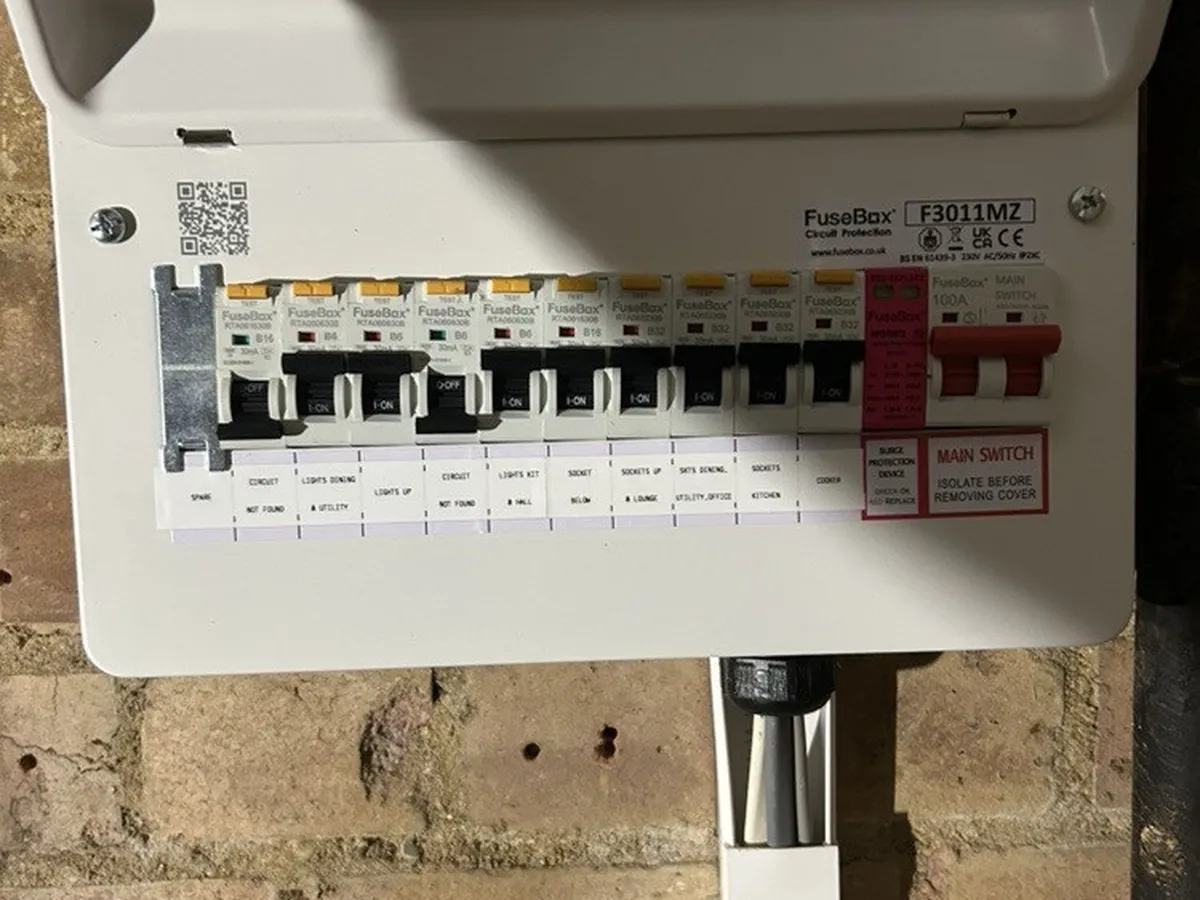
Fuse board, fuse box and consumer unit all mean the same thing here: the box, usually near the meter, that splits your supply into circuits and protects each one.
The short answer
With SEGplc, a fuse board replacement starts from £399 including VAT for a small 2-way board, for example for a garage, outbuilding or very small flat. Most homes need a bigger board, so for a whole house or flat we give a fixed written price after seeing photos of your board.
We do not publish one price for a whole house, because two homes of the same size can need very different work. The number of circuits, the state of the earthing and what the testing finds all change the job. This page explains what sets the price, so you can judge any quote you are given, including ours.
Fuse board replacement prices
| What you need | Price with SEGplc |
|---|---|
| A small 2-way board, for example for a garage, outbuilding or very small flat | From £399 including VAT |
| A new consumer unit for a whole house or flat | A fixed written price after we have seen photos of your board |
| Faults found when we test the existing circuits | Explained and quoted before we do them |
| Earthing or bonding that is not up to standard | Put right as part of the job, or quoted first |
The £399 covers the board, fitting, testing, your Electrical Installation Certificate and Building Regulations notification. Prices include VAT and are subject to survey.
What a consumer unit replacement should include
A proper fuse box replacement is more than swapping one box for another. This is what we include:
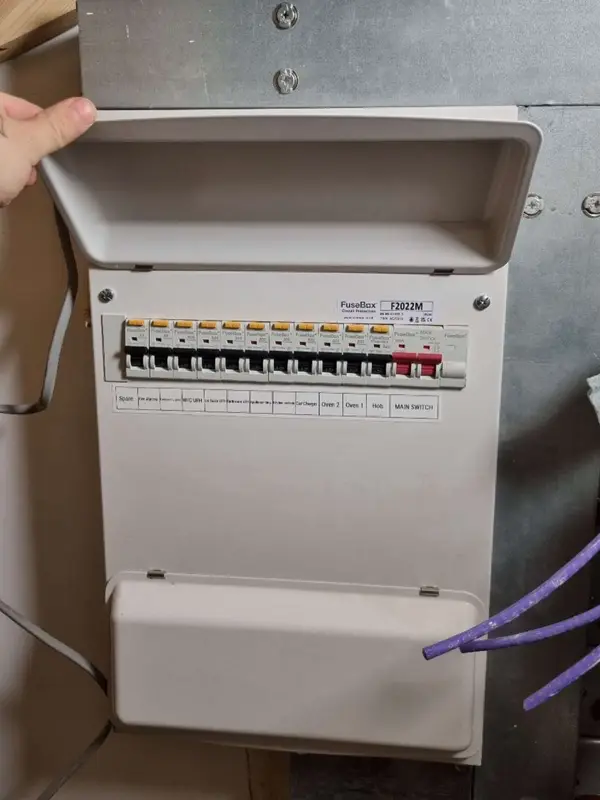
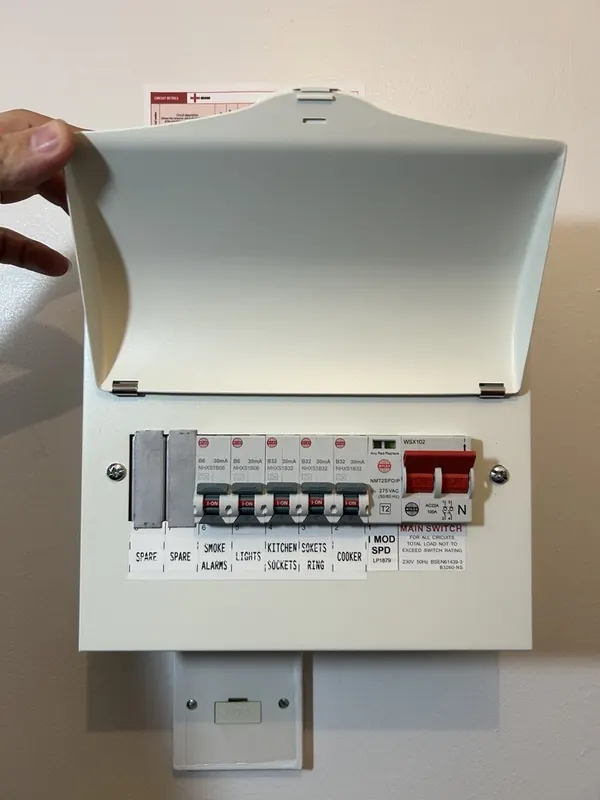
- A new metal consumer unit, sized for the property. The wiring regulations (BS 7671) require a non-combustible enclosure in homes, normally steel.
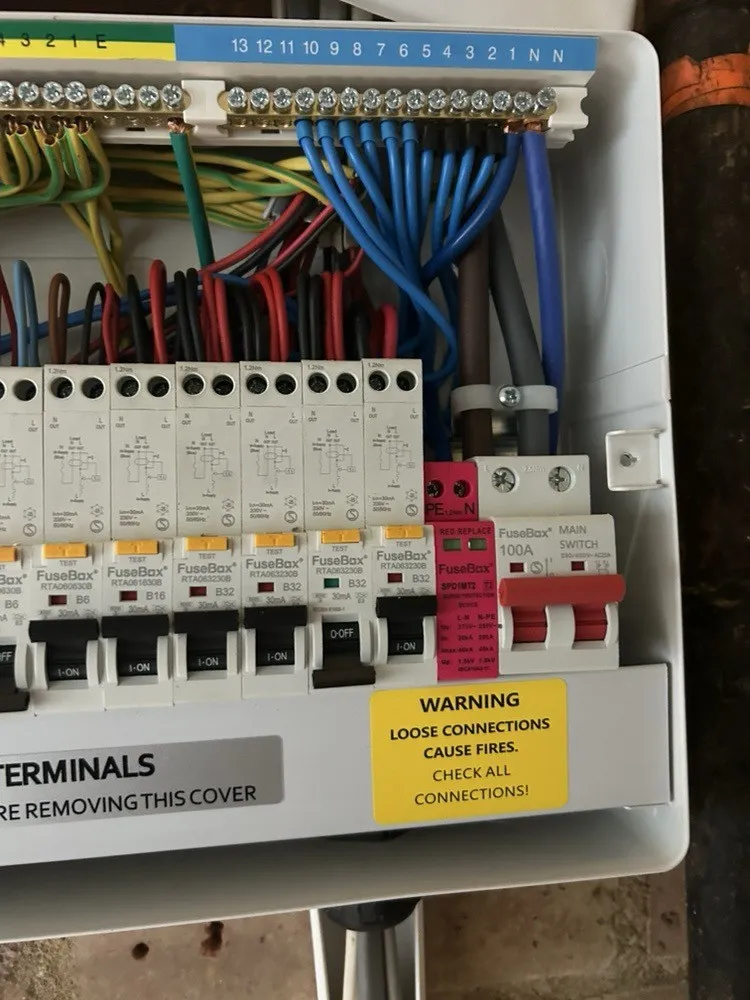
- RCBOs. A metal consumer unit with RCBOs is what we normally fit in homes now. Each circuit has its own protection, so a fault only switches off its own circuit and the freezer stays on.
- Surge protection where it is needed, which it is in most homes under the current wiring regulations.
- Arc fault detection (AFDDs) where required, for example on socket circuits in HMOs, and where you choose them elsewhere.
- Spare ways for future circuits, such as an EV charger or a garden office, and a clear label on every circuit.
- A test before we start. We test the existing circuits so any faults are found and explained before anything changes.
- A check of the earthing and bonding to the gas and water pipes.
- Every circuit tested once the new board is in, with the results recorded.
- The certificate. You get an Electrical Installation Certificate with those test results.
- Building control notification. Replacing a consumer unit is notifiable work under Part P of the Building Regulations in England. As an NICEIC-approved contractor we notify the work for you, and you receive a Building Regulations compliance certificate. Government guidance says it should reach you within 30 days of the work being finished.
More on the paperwork: electrical safety certificates explained.
What adds to the cost
- The number of circuits. This is the main one. More circuits means a bigger board, more RCBOs and more testing. A flat with 6 circuits costs less than a house with 14.
- Faults found on testing. A modern board will not stay on with a serious fault on a circuit, so faults have to be put right first. An old fuse box can hide them for years. We tell you what we find and quote before doing the work.
- Earthing and bonding upgrades. The main earth, and the bonding to the gas and water pipes, must be up to standard before a new board goes on. At a house in St Albans the gas bonding was only 6mm and we upgraded it to 10mm.
- Moving the board. Every circuit cable has to reach the new position, so moving a board costs more than replacing it where it is.
- More than one board. A garage, annexe or outbuilding often has its own. At a property in Hertford we replaced three: the house, the utility room and the garden outbuilding.
- The meter tails and the main fuse. See the next section.
- Access. A board boxed into a cupboard or behind fitted units takes longer to work on.
The main fuse and the meter tails: who does what
Not everything near your fuse board is yours, and not all of it is ours to touch. This matters when the cables feeding the board are too small or the main fuse needs upgrading.
| Part | Who it belongs to | Who works on it |
|---|---|---|
| The main fuse (the sealed cut-out beside the meter) | The network operator. For St Albans, Hertfordshire, Bedfordshire and London that is UK Power Networks. | Only the network operator can change it. Upgrading a 30 A or 60 A fuse to 80 A or 100 A is free in most cases. |
| The electricity meter | Your electricity supplier | Your supplier |
| The meter tails (the thick cables from the meter to your fuse board) | You | Your electrician. If they are the old 16 mm² size they may need replacing, and that is part of our quote. |
| The fuse board and everything after it | You | Your electrician |
The main fuse is sealed. It is not ours to remove without the network operator’s agreement. If there is no isolator switch between your meter and the fuse board, that needs sorting out before the day, and it can involve your supplier or the network operator. This is why we ask for a photo of the meter and the main fuse as well as the board.
Adding an EV charger, a heat pump or air conditioning at the same time? See is a 60 amp main fuse enough?
How long it takes, and how long the power is off
A consumer unit replacement usually takes most of a day in a typical home, and the power is off for much of that time. A small board can be quicker. A larger property, or one where faults are found or the earthing and bonding need upgrading, takes longer. We agree the timing with you beforehand.
- Tell us about anything that must stay on, such as medical equipment, before we start.
- Fridges and freezers will be off. Keep the doors shut.
- The wifi router will be off too, so plan around working from home.
Signs you need a new fuse board
- Pull-out fuses with fuse wire, or a mix of old fuses and circuit breakers.
- No RCD: no switch with a T or Test button anywhere on the board.
- A wooden backboard, or several separate boxes added over the years.
- An EICR that recorded the board as a problem.
- No spare ways for an EV charger, solar panels, a new kitchen or an extension.
Not every old board needs replacing. Our guide covers how to tell what you have: does my fuse board need replacing? If the electrics keep tripping, read RCD keeps tripping? first.
Why a cheap quote can cost more
Two quotes for a new fuse box can be far apart and both be honest. They are often not for the same job. Ask each electrician these questions:
| Ask | Why it matters |
|---|---|
| Are you registered with a competent person scheme, such as NICEIC? | A registered installer notifies building control for you. If they are not registered, the work has to go through building control another way, usually with a fee. You may be asked for the compliance certificate when you sell. |
| Does the price include testing every circuit, and the certificate? | A new board without test results is not finished. You should get an Electrical Installation Certificate. |
| RCBOs on every circuit, or two shared RCDs? | A board with two shared RCDs is usually cheaper, but one fault can switch off half the house. |
| Is surge protection included? | It is needed in most homes under the current wiring regulations, so check it is in the price. |
| What happens if you find a fault? | This is where cheap quotes grow. A clear quote says faults will be explained and priced before any extra work is done. |
| Have you allowed for the earthing and bonding? | If it is not up to standard it has to be put right. Better to know before the day. |
| Is VAT included? | Our homeowner prices include VAT. Check you are comparing like with like. |
A real job: an old Wylex board in Radlett
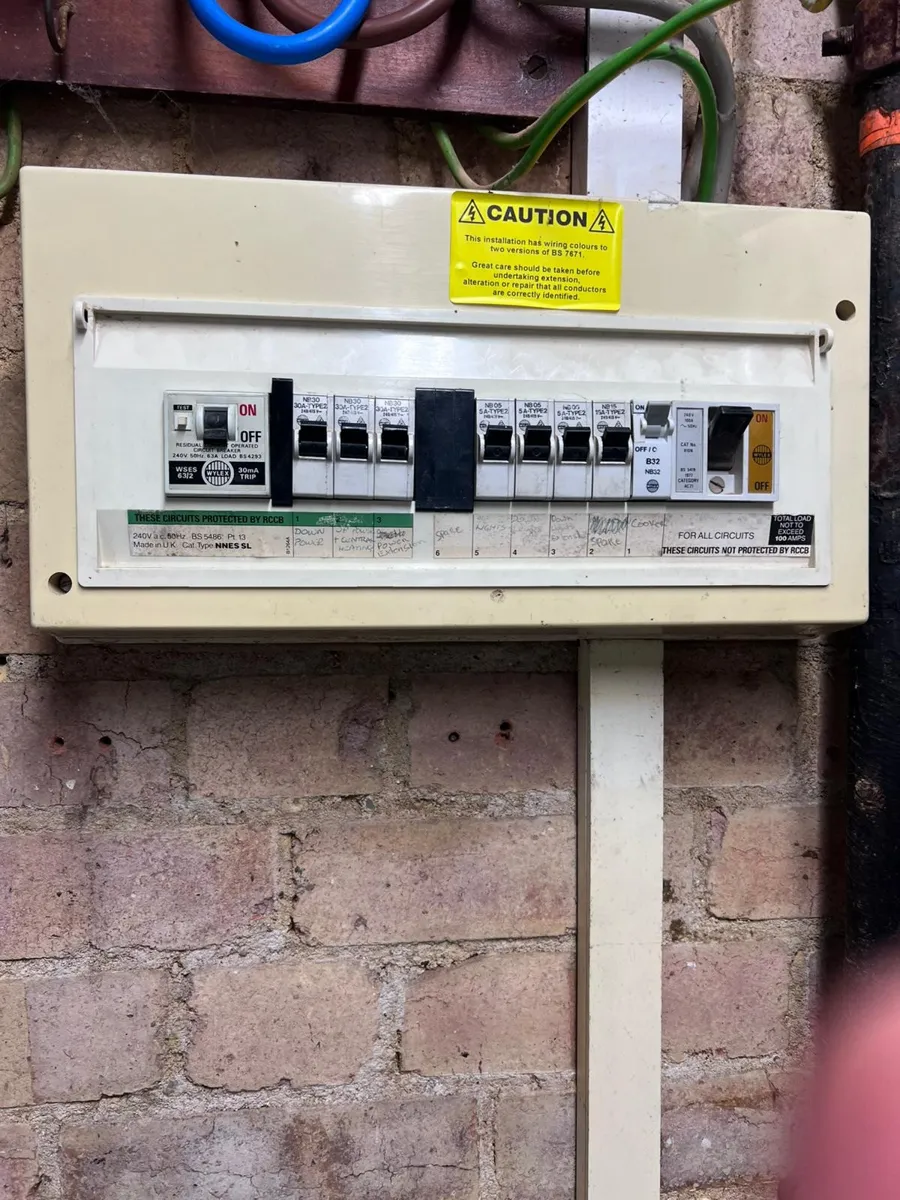
In November 2025 we replaced an old Wylex board in a family home in Radlett. It had a single RCD, and several circuits had no RCD protection at all. We fitted an all-RCBO consumer unit with surge protection and labelled every circuit.
Testing then showed what the old board had been hiding: high readings on the kitchen and hallway sockets, a 69.4V reading between live and earth on the upstairs lighting cables, and a damaged socket at the top of the stairs. We traced and fixed each one, including a shared feed in a loft junction box. We were on site for two days.
That is why we test before we start and tell you what we find. See the Radlett job.
Two more: a new EV board and upgraded gas bonding in St Albans, and three boards replaced after an EICR in Hertford.
What to send us for a fixed price
Photos are often enough for us to quote. Use the fuse board quote form and send:
- The whole fuse board, close enough to read the labels.
- A close-up of the switches, their labels and the main switch. Do not remove any covers.
- The electricity meter and the main fuse, the sealed fuse next to it.
- A few details: the type of property, why you want the board changed, and anything you plan to add, such as an EV charger or a new kitchen.
- Your last EICR, if you have one.
We come back with a fixed written price and agree the date with you.
Questions we’re asked
How much does it cost to replace a consumer unit?
With SEGplc, a new consumer unit starts from £399 including VAT for a small 2-way board, for example for a garage, outbuilding or very small flat. Most homes need a bigger board, and we give a fixed written price after seeing photos of yours.
How much does a fuse box replacement cost for a three-bed house?
We do not publish one price for a whole house, because it depends on the number of circuits, the state of the earthing and bonding, and what the testing finds. Send us photos of your fuse box, meter and main fuse and we will give you a fixed written price.
Is a fuse board the same as a consumer unit?
Yes. Consumer unit is the trade name. Most people say fuse board or fuse box. It is the box, usually near the meter, that splits your supply into circuits and protects each one.
How long does a fuse board replacement take, and how long is the power off?
Usually most of a day in a typical home, with the power off for much of that time. A small board can be quicker. A larger property, or one where faults are found, takes longer. A board we replaced in Radlett took two days because testing found faults that had to be traced and fixed.
Will I get a certificate for a new consumer unit?
Yes. Replacing a consumer unit is notifiable work under Part P of the Building Regulations in England. We issue an Electrical Installation Certificate and notify the work, and you receive a Building Regulations compliance certificate.
Why do quotes for a new fuse board vary so much?
They are often not for the same job. Check whether each quote includes RCBOs on every circuit, surge protection, testing every circuit, the certificate, building control notification and VAT, and what happens if a fault is found.
Will my house need rewiring before a new fuse board can be fitted?
Not necessarily. We test the existing circuits first. A fault on a circuit has to be put right before the new board goes on, but that is normally a repair to that circuit, not a rewire. If the wiring itself needs replacing we tell you before any work starts.
Who changes the main fuse?
The network operator. The main fuse beside the meter is sealed and belongs to them, not to you, your supplier or your electrician. UK Power Networks upgrade a 30 A or 60 A fuse to 80 A or 100 A free of charge in most cases.
Written by SEGplc. Prices include VAT and are subject to survey. Last updated 15 November 2026.
Need it done by a date?
Tell us the deadline. We’ll tell you honestly whether we can hit it — and we usually can.