

- Home
- Extractor fan installation
Extractor fan installation.
Bathroom and kitchen extractor fans replaced, or fitted where there has never been one: through the wall, in the ceiling with a duct through the loft, or in a window. Tested and certified.
Yes, we fit bathroom and kitchen extractor fans: a straight replacement for an old one, or a new fan where there has never been one. A new fan can go through an outside wall, in the ceiling with a duct through the loft, or in a window. We cover St Albans and the towns around it, across Hertfordshire, Bedfordshire, Buckinghamshire and North and West London.
Fan stopped, humming or will not switch off? See bathroom extractor fan not working first. It may only need a clean.
Replacing an old fan, or fitting one where there is none
These are two different jobs. Tell us which one you have and we can say what is involved.
| The job | What is involved | Paperwork |
|---|---|---|
| Like-for-like replacement | The old fan comes out and a new one goes in on the same wiring, the same hole and the same duct. The loft fan we replaced in St Albans in October 2026 took about an hour. | Tested before we leave, with a photo report. Not notifiable. |
| Replacement with a better fan | For example a plain fan swapped for one with a timer or a humidity sensor. A timer fan needs a second, permanent live feed as well as the one from the light switch, so an extra cable may be needed. | A Minor Works certificate where the wiring is altered. |
| A new fan where there is none | A hole through the wall or ceiling, a duct to the outside, a grille outside, a power supply (usually from the lighting circuit), an isolator and the control you choose. | A Minor Works certificate, and Building Regulations notification where it applies. See your certificate. |
Where the fan can go: wall, ceiling or window
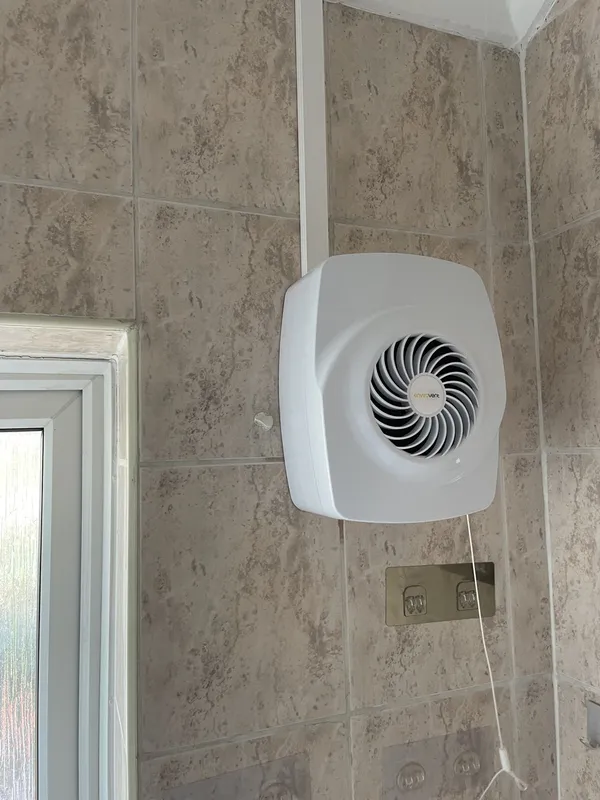
- Through an outside wall. The simplest route, because the duct is as short as it can be. We core-drill a round hole through the wall and fit a grille on the outside. On an upstairs wall the outside grille may have to be fitted from access equipment.
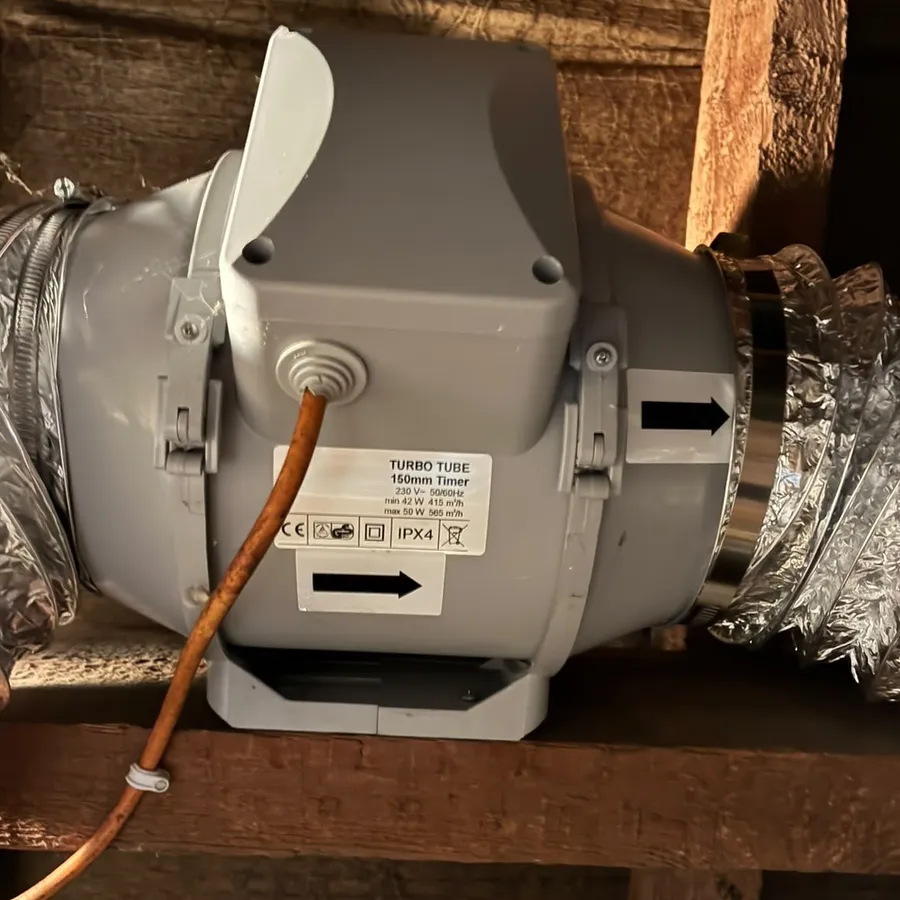
- In the ceiling, ducted through the loft. For a bathroom with no outside wall, or where the fan is wanted over the shower. The duct runs across the loft to a vent on the outside of the house. It must end outside: steam blown into the loft just moves the damp upstairs. The fan can be in the ceiling itself, or it can be an inline fan that sits in the loft with only a grille showing in the bathroom ceiling.
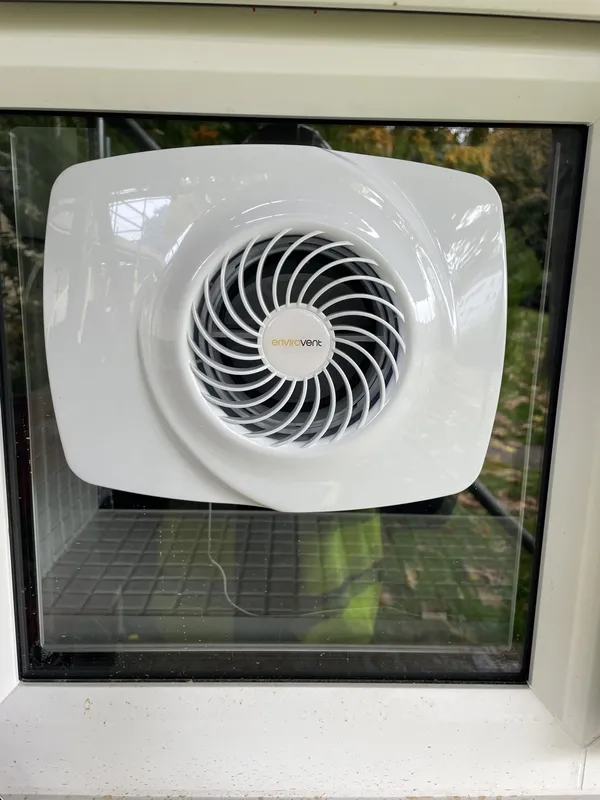
- In a window. A window fan kit lets the fan sit in the glass. It is the answer where a hole through the wall is not possible. In Stevenage we fitted 146 of them for that reason.
- Kitchens. Either a cooker hood ducted to the outside, or a fan in the wall or ceiling. A recirculating hood only filters the air and puts it back, so it does not count as extraction. If you are planning a new kitchen, put the hood outlet on the drawing: see kitchen and bathroom electrics.
Duct matters as much as the fan. The Building Regulations guidance asks for flexible duct to be kept short and pulled tight, and a long or sagging duct cuts the airflow. A duct through a cold loft is normally insulated so the steam does not turn back to water inside it.
How it switches on: timer, humidistat or pull cord
| Control | How it works | Worth knowing |
|---|---|---|
| With the light | The fan starts with the bathroom light and stops with it. | Simple, but it stops the moment you leave, while the room is still full of steam. |
| Timer (overrun) | Starts with the light and keeps running for a set time after the light goes off. | The usual choice. In a room with no window that opens, the guidance asks for at least 15 minutes of run-on. |
| Humidistat | A sensor starts the fan when the air gets damp and stops it when the room has cleared. Nobody has to remember. | Good for rented homes and busy households. It should also have a manual override. Not suited to a separate WC, where smell is the problem, not steam. |
| Pull cord | A cord on the fan or on a ceiling switch. You decide when it runs. | A cord can hang within reach of the bath or shower, where a wall switch is not allowed. |
| Continuous running | The fan runs at a low trickle all the time and boosts when the room is in use. | The type we fitted in 197 Stevenage homes in 2023. The boost has to be set properly, or it never clears the steam. |
Many fans combine these, for example a timer with a humidity sensor. Tell us how the room is used and we will suggest one.
The fan isolator
The fan isolator is the small switch you often see outside the bathroom door, usually above head height. It cuts the power to the fan on its own, so the fan can be cleaned, repaired or changed safely without switching off the lights. It is not meant for turning the fan on and off day to day.
A timer fan has two live feeds, one permanent and one from the light switch. A three-pole fan isolator switches off both, and the neutral, in one go. It sits outside the bathroom zones described below. Some fans are fed through a fused spur instead, and we fit what the fan maker’s instructions ask for.
If your fan has stopped, the isolator is the first thing to check. Someone may have switched it off.
Bathroom zones, in plain words
The wiring regulations (BS 7671) divide a bathroom into zones according to how wet each part gets. What can be fitted depends on the zone.
- Zone 1 is the space directly above the bath or shower tray, up to 2.25 metres from the floor, or up to the shower head if that is fixed higher.
- Zone 2 is the strip 0.6 metres wide (about two feet) around zone 1, to the same height.
- Outside the zones is the rest of the room.
What that means for a fan:
- A fan in zone 1 or zone 2 must be rated at least IPX4, which means splash-proof. Where it could be hit by water jets it must be at least IPX5.
- A mains fan can go in those zones if it is made for it. A low-voltage fan, with its transformer outside the zones, is the other option. In Stevenage the bathroom fans we fitted on the first phase ran at safety extra-low voltage.
- Ordinary wall switches and the isolator stay outside the zones. Only the cord of a pull-cord switch may hang inside them.
- Under today’s regulations every circuit serving a bathroom must be protected by a 30 mA RCD. If the lighting circuit has none, that has to be put right as part of fitting a new fan. Send a photo of your fuse board and we can check before we quote.
For lights in the same room see downlights and ceiling spotlights. Fitting a shower as well? See electric shower installation.
Damp and mould: why most people ask
The usual reason for wanting a fan is black mould on the bathroom ceiling, paint that peels, or windows that run with water. A shower or a boiling pan puts a lot of water into the air. If it is not taken outside, it settles on the coldest surfaces and mould follows.
- No fan at all. Common in older bathrooms that rely on a window. In winter the window stays shut.
- A fan that runs but does little. It may be too weak for the room, clogged, on a long or crushed duct, or switching off too soon. On 156 fan repair visits we made in sheltered housing, 62 fans needed only taking down and cleaning: see what we found.
- A warmer, more airtight home. New windows and insulation keep heat in and moisture too. That is why we fitted more than 830 extractor fans in 440 Stevenage homes alongside insulation work: see the Stevenage ventilation project.
A fan deals with condensation. It will not cure a leak or damp coming through a wall, so if the mould is in one patch on an outside wall or under a roof, have that looked at as well.
What the Building Regulations ask for, in outline
In England the guidance is Approved Document F. For a fan that runs when the room is in use, it sets these minimum extract rates:
| Room | Minimum extract rate |
|---|---|
| Bathroom | 15 litres per second |
| Kitchen, with a cooker hood ducted to the outside | 30 litres per second |
| Kitchen, with no hood or a recirculating hood | 60 litres per second |
| Utility room | 30 litres per second |
| Separate WC | 6 litres per second |
- Refurbishing a kitchen or bathroom: a fan that is already there should be kept or replaced. If the room never had one, the guidance does not make you add one, though it is usually worth doing.
- A new bathroom, shower room or utility room added to a house does need extraction.
- No window that opens: the fan should keep running for at least 15 minutes after you leave.
- The air must go outside, not into the loft or a ceiling void.
Source: Approved Document F, Volume 1: Dwellings, 2021 edition, which took effect in June 2022. A new edition takes effect on 24 March 2027; the extract rates above are the same in it.
Landlords
Damp and mould is a hazard your tenants can report, and a working fan is one of the simplest things you can do about it. Since 27 October 2025 social landlords in England have had to investigate significant damp and mould within 10 working days of being told about it (Awaab’s Law). The government has said it will extend the same rules to private renting.
- A humidistat or continuous-running fan suits a rented home, because it does not depend on anyone switching it on.
- Keep the certificate for the fan with your other electrical paperwork. Have it to hand at the next EICR.
- We can book the visit directly with your tenant or your letting agent. For several properties, ask about programme rates.
See electricians for landlords.
The certificate you get
- A like-for-like replacement is tested before we leave and you get a photo report. It is not notifiable.
- A new fan, or a change to the wiring, gets a Minor Electrical Installation Works Certificate (a Minor Works certificate): the test record for an addition to an existing circuit.
- A new circuit gets a full Electrical Installation Certificate. Few fans need one.
- Building Regulations (Part P). In England the work is notifiable if it is a new circuit, or if wiring is added or altered inside the bathroom zones, close to the bath or shower. As NICEIC-approved contractors we notify it for you and the compliance certificate is sent to you.
Our work comes with a 12-month workmanship guarantee. More on the paperwork: electrical safety certificates explained.
Fans we have fitted
From our own job records. Customers are not named.
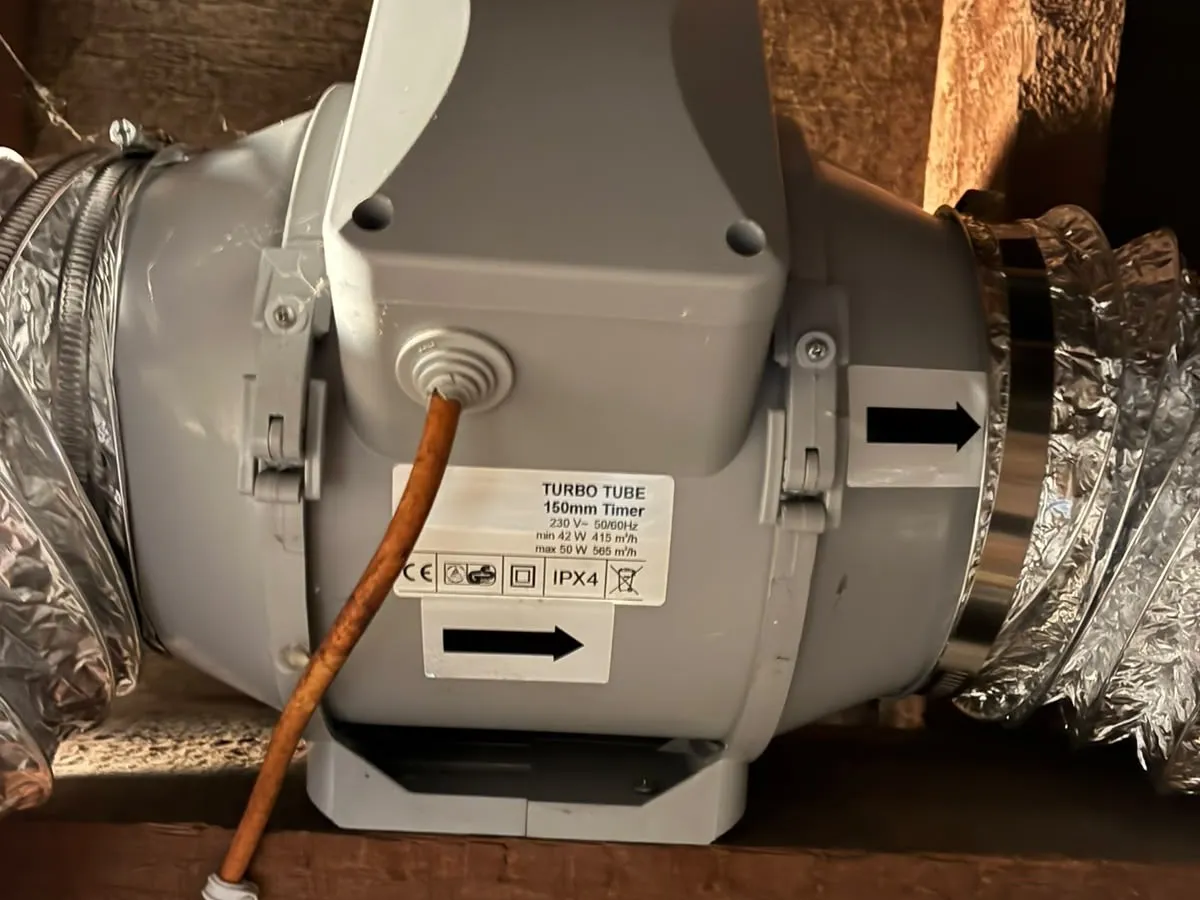
- St Albans, October 2026. A bathroom fan had stopped. It was an inline fan up in the loft. We went out the same day, found the supply was fine and the fan had failed, and fitted a new 150mm inline fan with a timer on the existing ducting. About an hour on site. See the job and photos.
- St Albans, June 2026. During a renovation we found a fan whose timer had never worked, because one of the wires that feeds it had not been connected. We replaced the inline fan and set its timer. See the job.
- Welwyn Garden City, April 2025. As part of a kitchen upgrade our engineer core-drilled the wall for a new kitchen extractor. See the kitchen.
- Stevenage. More than 830 extractor fans in 440 homes for Wates, in kitchens, bathrooms and WCs. That meant 239 new holes cored through outside walls and 146 window fan kits where a wall fan was not possible. See the project.
What to send us for a quote
Photos save a lot of back and forth and help us bring the right fan first time. Send what you can:
- Which room, and whether there is a fan there now.
- A photo of the old fan, or of the wall or ceiling where you want the new one.
- What is behind it: an outside wall, a loft above, or a flat above. For a wall fan, a photo of the outside of that wall and which floor it is on.
- Whether the room has a window that opens. For a window fan, tell us if the glass is single or double glazed.
- How you want it to switch on: with the light, on a timer, by humidity or on a pull cord.
- A photo of your fuse board with the cover open.
- Any mould or damp you are trying to cure, and where it is.
- Whether you have already bought a fan. We can usually fit it if it suits the position.
Questions we’re asked
Can you fit a fan where there isn't one?
Yes. A new fan can go through an outside wall, in the ceiling with a duct through the loft to the outside, or in a window. In Stevenage we cored 239 new holes through outside walls and fitted 146 window fan kits where a wall fan was not possible.
Why does my fan run after the light is off?
It has an overrun timer. The fan keeps going for a set time after the light goes off to clear the steam that is still in the room. In a room with no window that opens, Building Regulations guidance asks for at least 15 minutes. A fan that never stops usually has a faulty timer or humidity sensor.
Do I need an electrician to fit an extractor fan?
A new fan is an addition to your mains wiring, in a room where water and electricity are close together, so it should be fitted, tested and certified by a qualified electrician. Close to a bath or shower the work is also notifiable under Part P of the Building Regulations in England, and a registered electrician can notify it for you.
Does a bathroom with a window need an extractor fan?
If you are refurbishing a bathroom that has never had a fan, Building Regulations guidance does not make you add one. A new bathroom or shower room does need extraction. In practice a fan clears steam far better than a window, which tends to stay shut in winter.
What size extractor fan do I need?
Approved Document F asks for at least 15 litres per second in a bathroom, and in a kitchen 30 litres per second with a cooker hood ducted outside or 60 without. A long duct cuts what a fan delivers, so a fan ducted through the loft may need to be more powerful than one fitted straight through the wall.
Can a fan go above the shower?
Yes, if it is made for that position. Above a bath or shower the fan must be rated at least IPX4, which means splash-proof, and the circuit must be protected by a 30 mA RCD. It can be a suitable mains fan or a low-voltage one with its transformer away from the shower.
Do I get a certificate for a new extractor fan?
Yes. A new fan or a change to the wiring gets a Minor Works certificate. Where the work is notifiable, such as wiring added close to the bath or shower, we notify it through NICEIC and you get a Building Regulations compliance certificate. A like-for-like replacement is tested and you get a photo report.
How long does it take to fit an extractor fan?
A like-for-like replacement is a short visit: the loft fan we replaced in St Albans in October 2026 took about an hour. A new fan takes longer because of the hole, the duct and the cable route, and it depends on the house. We tell you when we quote.
Written by SEGplc. Last updated 15 November 2026.
Need it done by a date?
Tell us the deadline. We’ll tell you honestly whether we can hit it — and we usually can.