

- Home
- Lights not working
Lights not working? What to check first.
Start with how many lights are out. Then the bulb, the switch and the fuse board, what to do about a bathroom pull cord, and what actually fixed 535 lighting call-outs in our repair data.
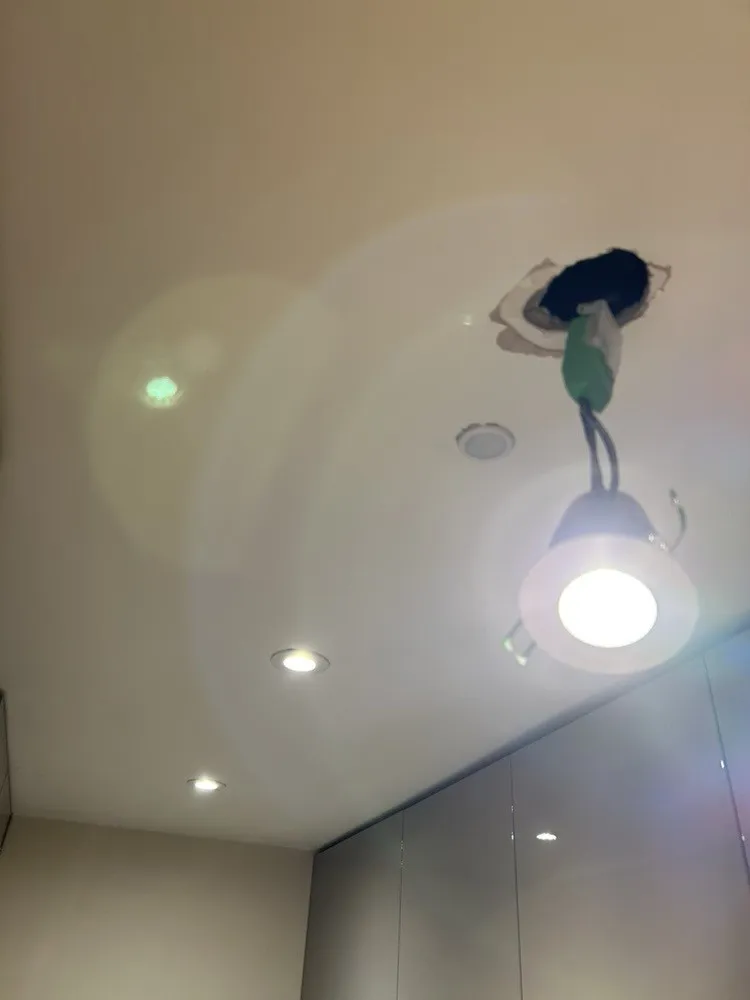
First, how many lights are out?
Lights run on their own circuits, separate from the sockets. So the pattern of what has gone off tells you where to look.
| What you see | Most likely cause | Where to go next |
|---|---|---|
| One light out, the rest fine | The bulb, then the fitting, the lampholder or the switch | Try a known-good bulb, then read on |
| New bulb, still nothing | The light fitting or a loose connection in it | What we found |
| Every light in one room out | The switch, or a connection at the switch or first light | Check the board, then call us |
| All the lights out, sockets working | The lighting breaker has tripped, or a fuse has blown | Safe checks |
| Lights and sockets out in half the house | An RCD has tripped and taken several circuits with it | No power in half the house |
| A breaker or RCD trips again when you reset it | A fault on a circuit or a faulty appliance | RCD keeps tripping |
| Light flickers or buzzes | Bulb, dimmer, or a loose connection | Lights flickering |
| Water dripping from the light | A leak above it | Switch off at the board: water through a light |
Safe checks you can do
- The bulb. Switch off and let it cool, then fit a bulb you know works, with the same cap (bayonet, screw or GU10). If the light is on a dimmer, it needs a dimmable LED. Philips says “many conventional or budget LED bulbs are not designed to dim”, and that dimming a non-dimmable LED “can cause flickering, buzzing, or even damage to the bulb and switch”. Philips also advises pairing dimmable LEDs with a compatible dimmer. Two of our call-outs ended with dimmable bulbs being fitted.
- The switch. If it feels loose, doesn’t click, or a two-way light only works from one end, the switch may have failed. Leave the cover on: we replaced 36 light switches in our data.
- The fuse board. Look for a breaker (MCB or RCBO) marked lights or lighting that is down or in the middle. Push it fully off, then on, once. If it stays on, check the lights. If it trips again, leave it off and call us: something on that circuit has a fault. On an older board with fuse carriers, call an electrician rather than repairing the fuse.
- Stop there. Don’t take down a fitting or open a switch. If a fitting is hot, scorched, buzzing or smells of burning, switch the lighting circuit off at the board.
Bathroom pull cord not working
Bathroom lights are usually worked by a pull switch in the ceiling. It fails in three ways:
- The cord has snapped, or the knot inside has slipped, so pulling does nothing. Sometimes a new cord is enough. Often the whole switch is renewed.
- The mechanism has stuck. No click, or the cord doesn’t spring back. The switch needs replacing.
- The cord has been pulled out, or the switch has come away from the ceiling. Switch the lighting off at the board and leave it for an electrician.
In our data we renewed 29 ceiling pull switches on lights, 18 of them in bathrooms. On 7 of the 29 visits the light fitting was renewed too. Two shaver lights needed a new cord rather than a new unit. The thicker 45A pull switch for an electric shower is a different switch: see electric shower not working.
What we found on our lighting call-outs
Between July 2025 and June 2026 our engineers attended 535 call-outs about lights inside residents’ homes, at 494 different sites (mostly single flats) across 93 postcode districts, in Anchor sheltered housing for Axis Europe. We counted them from the repair codes on each job sheet:
| What fixed it | Call-outs | Share |
|---|---|---|
| New light fitting: 199 square or round fittings, 86 standard 18W LED fittings, 22 shaver lights, 7 sealed bathroom lights and 2 LED fittings with sensors | 311 | 58% |
| New pendant, lampholder, ceiling rose or batten holder | 72 | 13% |
| Light taken down, connections checked and refitted | 44 | 8% |
| Bulb only: no other part replaced | 43 | 8% |
| New light switch | 36 | 7% |
| New ceiling pull switch (plus 2 new cords on shaver lights) | 29 | 5% |
| Working when we arrived | 14 | 3% |
| Connections re-made: loose, snapped or wired the wrong way round | 10 | 2% |
| Lighting circuit tripped, switched off or fuse blown, and put back on | 8 | 1% |
| Faulty RCD, RCBO or breaker replaced at the board | 3 | 1% |
| Lighting on a 32A breaker and the cooker on a 6A or 10A one | 2 | <1% |
Some call-outs involved more than one item, so the rows overlap and don’t add up to 535. Not included: more than 300 further call-outs for communal and outside lights (corridors, stairwells, car parks, lamp posts), 15 electric shower pull switches, and void EICRs.
Some of the faults behind those numbers: a live wire snapped inside the terminal of a living room light; a pendant that kept burning out bulbs until the pendant itself was replaced; a bathroom fitting with a failed transformer; and, twice, a lighting circuit on a 32A breaker with the cooker on a 6A or 10A one. Once we swapped them round; the other time the whole board was replaced.
What it means for you
If a new bulb doesn’t fix it, the fitting or its connections are the usual cause. Fewer than one in ten of our call-outs needed only a bulb. More than half needed a new fitting, and about one in seven a new pendant, lampholder or ceiling rose. Many of the replacements are LED fittings. If the lights are all out at once, the cause is more likely at the fuse board than in the fittings.
Bathroom lights came up a lot: 158 of the 535 job sheets mention a bathroom. In those bathroom jobs, 138 needed a new fitting and 18 a new pull switch. So if the pull cord clicks normally, suspect the fitting.
Tenants and landlords: who repairs it?
For a home let on a lease of under seven years granted since 24 October 1961, section 11 of the Landlord and Tenant Act 1985 says the landlord must “keep in repair and proper working order the installations in the dwelling-house” for the supply of electricity. That does not cover “other fixtures, fittings and appliances for making use of the supply”, so your own lamps and appliances are yours. In a block, it can also cover installations elsewhere in the building that serve your home, where the landlord owns or controls them.
Private landlords in England must also ensure the electrical safety standards are met while the home is let, have the installation inspected and tested at least every five years, and have any remedial work the report calls for done within 28 days (or sooner if the report says so), under the Electrical Safety Standards in the Private Rented Sector (England) Regulations 2020. Check your tenancy agreement for who replaces bulbs, and report anything else to your landlord in writing. In the homes in our data, the repair requests reached us from Anchor through Axis Europe. See electricians for landlords.
When is lighting work notifiable?
In England, Approved Document P sets out which electrical work must be notified to building control:
| Job | Notifiable? |
|---|---|
| Replacing a light fitting, switch, pull switch or ceiling rose | No: “replacements, repairs and maintenance anywhere” are not notifiable |
| Adding a light to an existing circuit in a living room or bedroom | No |
| A new lighting circuit | Yes |
| Replacing the consumer unit | Yes |
| Adding to or altering a circuit in the zone around a bath or shower (to 2.25m high, and 0.6m from the bath or shower tray) | Yes |
Work that isn’t notifiable must still be designed, installed, inspected and tested to BS 7671. If the job turns into a new circuit or a new board, see consumer unit replacement.
How SEGplc can help
We are an NICEIC Approved Contractor based at SEG House, Chiswell Green. We find lighting faults, replace fittings, switches and pull switches, and fix tripping lighting circuits for homeowners, landlords and housing providers. Most single lights are a small job. For housing providers, see responsive repairs and sheltered housing repairs.
Questions about lights not working
Why is my light not working when the bulb is new?
Check the new bulb has the right cap and, if the light is on a dimmer, that it is a dimmable LED. If it still won’t light, the fault is usually the fitting or its connections. In our repair data, a new light fitting was the fix in 311 of 535 lighting call-outs, and only 43 needed nothing more than a bulb.
Why are my lights not working but the sockets are?
Lights and sockets are on separate circuits. If every light is out and the sockets work, the lighting breaker (MCB or RCBO) has probably tripped, or an old-style fuse has blown. Switch the breaker back on once. If it trips again, leave it off and call an electrician.
Why are the lights not working in one room?
Usually a faulty switch or a loose connection at the switch or the first light in that room. If the room has its own breaker, check that too. Don’t open the switch or fitting yourself.
Why has my bathroom pull cord stopped working?
The cord has snapped, the mechanism inside has jammed, or the cord has come out of the switch. A new ceiling pull switch is a small job. We renewed 29 of them in a year of repairs in sheltered flats, most of them in bathrooms.
Why is my shaver light not working?
Try a new lamp first. If that doesn’t work, the pull cord or the unit has usually failed. In our data, 22 shaver lights were replaced complete and two needed a new cord instead.
Do I need a certificate to replace a light fitting?
In England, replacing a light fitting is a replacement or repair, which Approved Document P says is not notifiable. A new circuit is. So is adding to or altering a circuit in the zone around a bath or shower. All work should still be done to BS 7671.
Who pays to fix a light in a rented home?
For most tenancies of under seven years, the Landlord and Tenant Act 1985 makes the landlord keep the electrical installation in repair and proper working order. Check your tenancy agreement for who replaces bulbs, and report anything else to your landlord in writing.
Sources
- legislation.gov.uk, Landlord and Tenant Act 1985, section 11: repairing obligations in short leases
- legislation.gov.uk, Landlord and Tenant Act 1985, section 13: leases to which section 11 applies
- legislation.gov.uk, The Electrical Safety Standards in the Private Rented Sector (England) Regulations 2020
- legislation.gov.uk, Regulation 3: duties of landlords in relation to electrical installations
- GOV.UK, Electrical safety: Approved Document P
- GOV.UK, Approved Document P, 2013 edition (PDF), paragraphs 2.5 to 2.8 and 3.13
- Philips Hue (Signify), Can LED bulbs be dimmed?
- Philips Lighting (Signify), Dimmable LED
Written by SEGplc, NICEIC Approved Contractor, SEG House, Chiswell Green, St Albans. Repair figures from our job sheets for Anchor sheltered housing, July 2025 to June 2026. Last updated 27 October 2026. This is general guidance, not legal advice.
Need it done by a date?
Tell us the deadline. We’ll tell you honestly whether we can hit it — and we usually can.