

- Home
- Electric cooker installation
Electric cooker, oven and hob installation.
What can plug in, what must be hard-wired on its own cooker circuit, and what we need to know to quote. Connected, tested and certified by our own NICEIC-approved electricians.
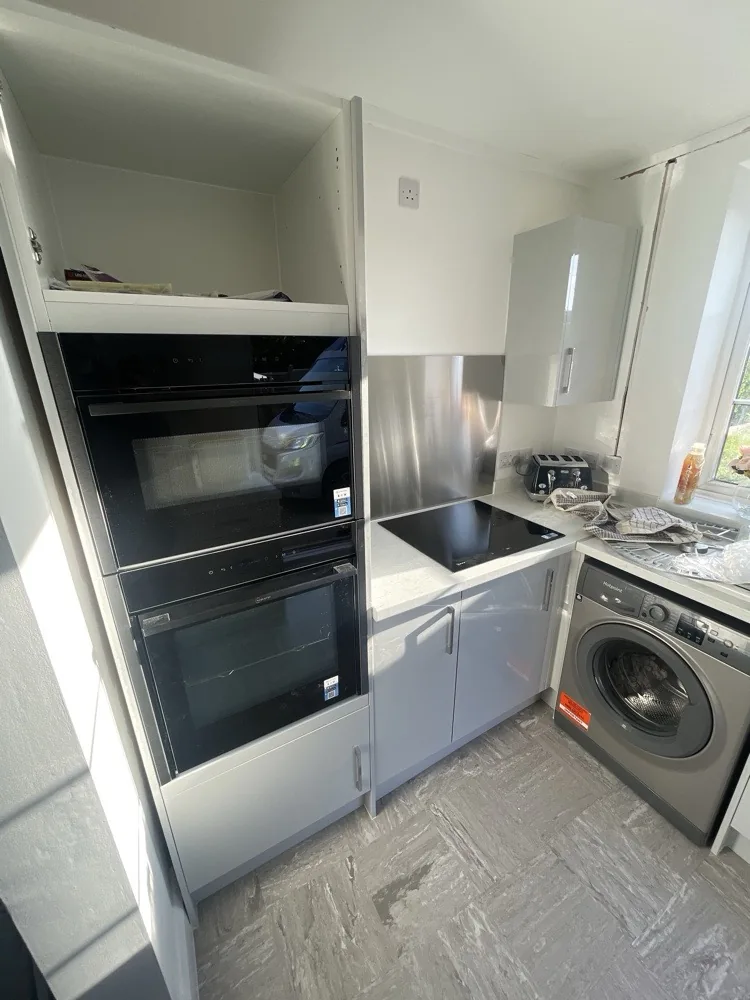
A single oven that comes with a plug can usually go into a socket. Most electric cookers, double ovens and hobs cannot: they must be hard-wired to a cooker circuit of the right size. SEG checks the circuit you have against the appliance you are buying, connects and tests it, and puts in a new circuit where one is needed, with the certificate.
Which appliances plug in, and which are hard-wired?
It comes down to how much power the appliance uses. A 13 amp plug can carry about 3 kW. An appliance that can draw more than that has no plug, and is wired straight into the house wiring. The maker decides which it is, so start with the rating plate or the specification sheet: look for “connected load” or “total electricity loading”.
| Appliance | How it is usually connected | What to check |
|---|---|---|
| Built-in single oven supplied with a plug | Plugs into a socket. NEFF says to use the plug if one is supplied. | That there is a socket it can reach once the oven is in its housing, and that the circuit is not already heavily loaded. |
| Built-in single oven supplied without a plug | Hard-wired to a cooker circuit or other suitable circuit. | The rating plate. Do not fit a plug to an oven that is made to be hard-wired. |
| Double oven | Hard-wired on a cooker circuit. | Whether the existing circuit is big enough, especially if a hob shares it. |
| Freestanding electric cooker (oven and hob in one) | Hard-wired on its own cooker circuit, through a cooker switch. | The total rating of the new cooker against the circuit that is there now. |
| Electric range cooker | Hard-wired on its own cooker circuit. | Large range cookers can need a bigger circuit than the one a standard cooker used. |
| Induction or ceramic hob | Almost always hard-wired on a cooker circuit. | The hob’s total rating. A few “plug and play” induction hobs are made for a socket and share a limited amount of power between the rings. |
| Dual fuel cooker (gas hob, electric oven) | The electric side is plugged in or hard-wired, depending on the model. The gas side is for a Gas Safe registered engineer. | The installation instructions for the electric oven’s rating. |
Some examples from makers’ own listings, checked in November 2026: Bosch lists one built-in single oven at 2.4 kW with a 13 amp plug fitted. AEG lists another single oven at 3.49 kW, a double oven at 4.3 kW and a four-ring induction hob at 7.35 kW, each marked “hardwired connection only”. So two ovens that look alike in the showroom can need quite different wiring.
Electrical Safety First’s advice is to check the power the oven needs before you buy, so the wiring is not overloaded, and to have it fitted by a qualified electrician.
The cooker switch and the connection unit
A hard-wired cooker, oven or hob has three parts on the wall side:
- The cooker circuit. A cable from its own breaker in the fuse board, kept for the cooking appliances.
- The cooker switch. A large switch on the wall near the appliance that cuts its power completely, for cleaning, repairs or an emergency. Some have a socket on the same plate; that is a cooker control unit. NICEIC says the switch should not be directly above or behind the hob or oven, so you never have to reach over a hot pan to turn it off.
- The connection unit (also called a cooker outlet plate). A plate low down behind or beside the appliance, where its cable joins the house wiring.
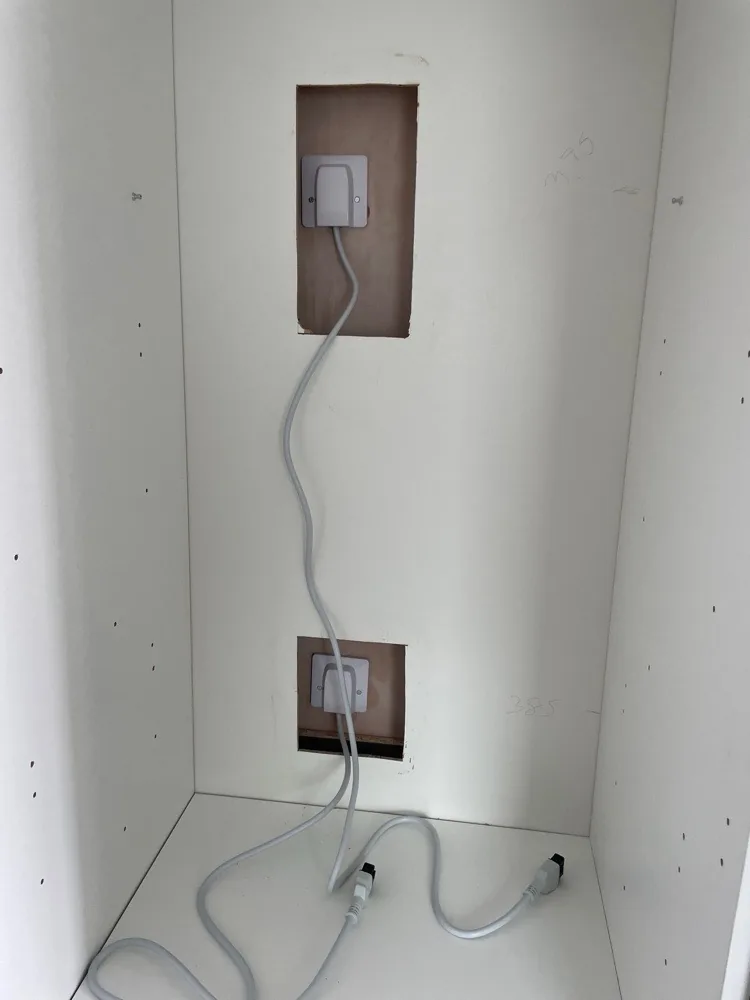
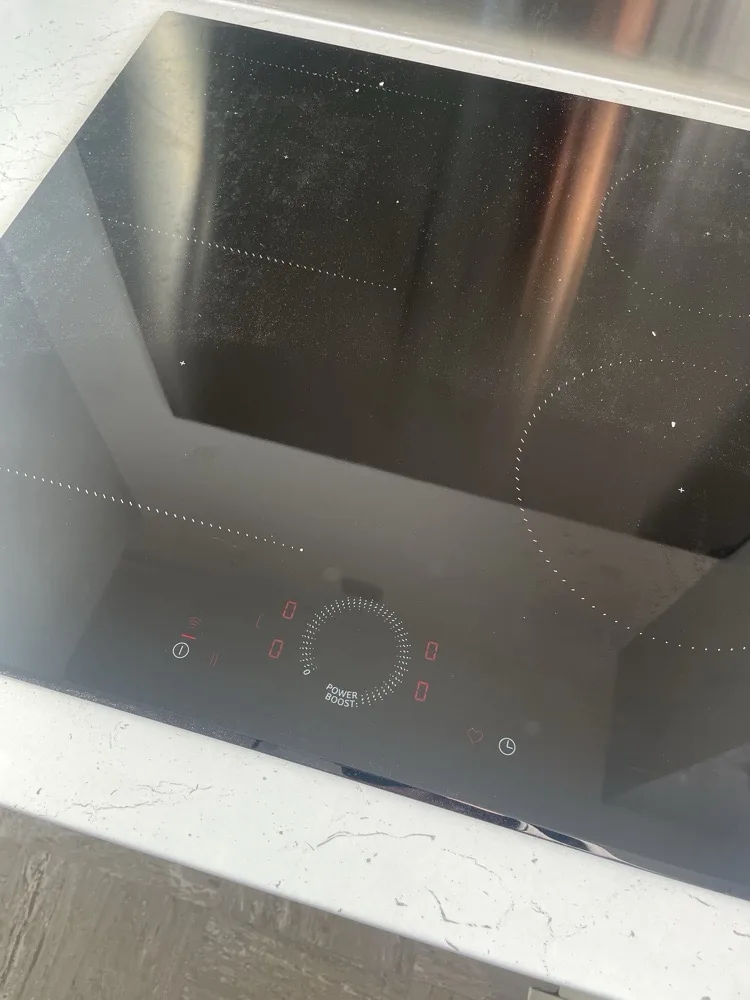
When we connect an appliance we check all three, not just the last length of cable. A cooker draws a heavy current for a long time, so a worn switch or a loose connection gets hot. In our repair records, 14 of 57 oven, hob and cooker jobs ended with a cooker switch, control unit, outlet plate or fused spur being replaced: see oven keeps tripping the electrics.
Why a new induction hob or double oven can need a new or bigger circuit
A cooker circuit is sized for the appliance it was put in for. Swap that appliance for a more powerful one and the old circuit may no longer be enough. The common cases:
- Gas hob to induction hob. A gas hob takes its heat from the gas. An induction hob takes all of it from the electrics: the four-ring example above is rated at 7.35 kW. Electrolux says most induction hobs cannot be plugged into a 13 amp socket and must be hard-wired by a qualified electrician.
- Single oven to double oven. Beko’s explanation for one of its ovens is simple: it has two heating elements, so it needs a higher amperage circuit.
- A plug-in oven and a new hob. A kitchen that only ever had a plug-in oven and a gas hob may have no cooker circuit at all.
- An oven and a hob on one circuit. One cooker circuit often feeds both. Whether yours can depends on the two ratings added together and on the cable and breaker already there.
- A range cooker in place of a standard cooker. More ovens and more rings mean a higher total rating.
The circuit is not simply sized for every ring and both ovens on full at once, because that almost never happens. An electrician works out the realistic demand under the wiring regulations (BS 7671), then checks the cable, the breaker and the cooker switch against it. That is a calculation for the electrician on the job, not something to guess from a chart, which is why we ask for the model before we quote. Where a new circuit is needed, we run a new cable from the fuse board to a new cooker switch.
Swapping a gas cooker or hob for electric
We do the electrical side only. Disconnecting, capping or removing a gas cooker or hob is gas work, and it must be done by a Gas Safe registered engineer. We do not do gas work.
- Check the electrics before you buy. If the old cooker was gas there may be no cooker circuit, only a socket nearby. A new circuit then has to be run from the fuse board.
- Book the gas engineer to disconnect and cap the gas supply and take the old appliance out.
- We put in the circuit, the cooker switch and the connection unit, then connect and test the new appliance.
- Dual fuel cookers need both trades: a Gas Safe registered engineer for the hob, and the right electrical supply for the ovens.
If the kitchen is being refitted at the same time, the cable is best run before the units and tiles go in. See kitchen and bathroom electrics for how we work alongside a kitchen fitter.
When the fuse board needs work first
A new cooker circuit starts at the fuse board (consumer unit), so the board has to be able to take it. We look for:
- A spare way. There must be space for one more breaker.
- RCD protection. A new cable buried in a wall normally needs RCD protection. If your board has pull-out fuses or no RCD, it cannot protect a new circuit properly as it stands.
- The right breaker for the cooker. On repair call-outs we have found cookers on 6A and 10A breakers, with the lighting wrongly on the 32A one.
- Earthing and bonding. These have to be adequate before a circuit is added, so we check the main earth and the bonding to the gas and water pipes.
- The main fuse. A big induction hob or range cooker added to a home that already has an electric shower and an EV charger can push the total up. See is a 60 amp main fuse enough?
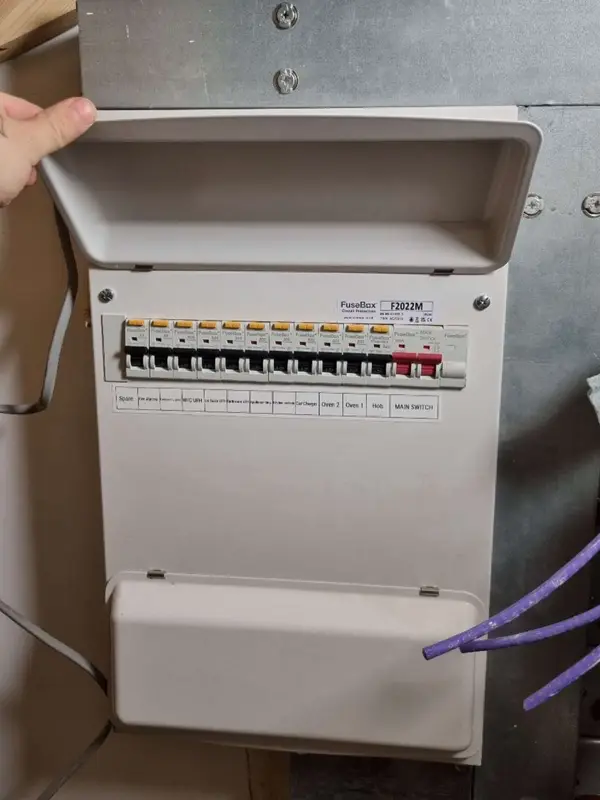
Often the answer is one extra breaker in the board you have. Sometimes the board has to be replaced first. See does my fuse board need replacing? and fuse board replacement. We tell you which before any work starts.
The certificate and Part P notification
| The job | Paperwork you get |
|---|---|
| A new cooker circuit | An Electrical Installation Certificate, and a Building Regulations compliance certificate, because a new circuit is notifiable under Part P. |
| A new cooker switch or connection unit, or an altered circuit | A Minor Works certificate with the test results. Not notifiable in a kitchen. |
| A new fuse board | An Electrical Installation Certificate and a Building Regulations compliance certificate. Replacing a consumer unit is notifiable. |
In England, Part P of the Building Regulations covers electrical work in homes. Putting in a new circuit is notifiable work, wherever in the house it is. As an NICEIC Approved Contractor we certify our own work and notify it for you. The Building Regulations compliance certificate must reach you within 30 days of the work being finished, and building control is told in the same period. Keep it with the house papers: solicitors ask for it when you sell.
Swapping one appliance for another on a circuit that is already suitable is not notifiable, but it should still be tested. More on the paperwork: which electrical certificate do you need?
Cooker and kitchen work from our job records
- Cookers connected for homeowners in Wheathampstead (October 2025) and Letchworth (December 2025). See small electrical jobs.
- 109 kitchen upgrades in Welwyn Garden City since 2024, on a housing improvement programme for Novus Property Solutions: ring mains, cooker circuits, appliance outlets, extractors and heat alarms. In one of those kitchens, in April 2025, our engineer Luke rewired the kitchen ring and the cooker circuit, then came back at second fix to connect the oven, hob and microwave, check each one worked and test the circuits. The house got an Electrical Installation Certificate.
- 57 oven, hob and cooker repair jobs in Anchor sheltered housing for Axis Europe, July 2025 to September 2026. Eight were cookers connected, reconnected, moved or made safe. Most of the rest were faults, and they show what goes wrong when a cooker is on the wrong breaker or a tired switch.
If the oven you already have is tripping the electrics, that is a different job: see oven keeps tripping or, for other appliances, appliance tripping the electrics.
What to send us for a quote
Three things tell us what the job involves:
- The appliance. The make and model number, or the kW rating from the rating plate or the specification sheet. If you have not bought it yet, send the one you are thinking of.
- A photo of the cooker switch, and of the outlet behind the cooker if you can see it.
- A photo of the fuse board with the cover or flap open, so we can read the labels and the breakers.
Tell us too whether the old appliance is gas or electric, and whether the kitchen is being refitted. We work for homeowners, landlords and housing providers across Hertfordshire and London.
Questions we’re asked
Can I plug an oven into a normal socket?
Only if the maker supplies it with a plug. A 13 amp plug can carry about 3 kW, so many built-in single ovens come with one. Double ovens, cookers and most hobs use more than that and must be hard-wired. Do not fit a plug to an appliance that is made to be hard-wired.
Does an induction hob need its own circuit?
Nearly always it needs a cooker circuit, not a socket. Electrolux says most induction hobs cannot be plugged into a 13 amp socket and must be hard-wired by a qualified electrician. The exception is a plug and play hob, which is made for a socket and shares a limited amount of power between the rings.
Can an oven and a hob share one cooker circuit?
Often, yes. Many kitchens have one cooker circuit feeding both. Whether yours can depends on the two ratings and on the cable and breaker already there, which an electrician checks before connecting them.
Do I need an electrician to install an electric cooker?
For anything hard-wired, yes. Electrical Safety First says to have an oven fitted by a qualified electrician, and makers such as Electrolux say all electrical connections should be made by one. An oven supplied with a plug simply plugs in, as long as the socket and its circuit are suitable.
Can you replace my gas cooker with an electric one?
We do the electrical side: the cooker circuit, the cooker switch, and connecting and testing the new appliance. Disconnecting and capping the gas must be done by a Gas Safe registered engineer. We do not do gas work.
Will I get a certificate?
Yes. A new cooker circuit comes with an Electrical Installation Certificate and, because a new circuit is notifiable under Part P in England, a Building Regulations compliance certificate within 30 days. Smaller changes, such as a new cooker switch, come with a Minor Works certificate.
Will I need a new fuse board for a new cooker?
Not usually. Often one extra breaker in the existing board is enough. The board needs work first if there is no spare way, no RCD protection, or it still has pull-out fuses. We tell you from a photo of the board.
How much does it cost to install an electric cooker?
It depends on whether the existing circuit suits the new appliance or a new one has to be run from the fuse board. Send us the model and photos of the cooker switch and fuse board, and we give you a written quote before any work starts.
Sources
- Electrical Safety First, Ovens and grills
- NICEIC, Kitchens and electrics: what you need to know
- GOV.UK, Approved Document P: electrical safety in dwellings
- HSE, Domestic gas: frequently asked questions
- Gas Safe Register, Gas appliances and home improvement
- NEFF, Can my oven be hardwired?
- NEFF, How does the plug-and-play induction hob work?
- Electrolux, How do I connect my electric ceramic or induction cooker to the power supply?
- Beko, Why does this appliance need a higher amperage electrical circuit?
Written by SEGplc, NICEIC Approved Contractor, SEG House, Chiswell Green, St Albans. Appliance ratings are examples from makers’ listings and vary by model: always go by the rating plate on yours. Last updated 15 November 2026.
Need it done by a date?
Tell us the deadline. We’ll tell you honestly whether we can hit it — and we usually can.