

- Home
- Sparking socket
Sparking socket or a burning smell?
When a spark is normal and when it isn’t, the warning signs to act on, what causes a socket or plug to overheat, and what to do right now.
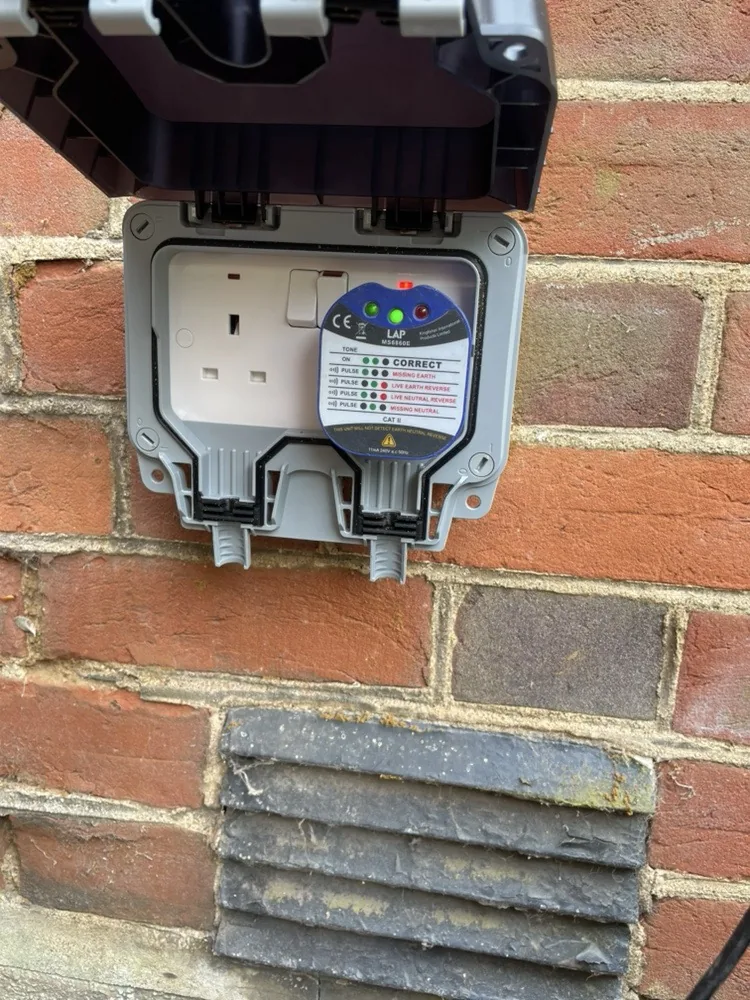
A burning smell or a spark from a socket is one of the few electrical faults that can get worse on its own. The good news is that it usually gives warning first, and the cause is almost always one of a handful of things: a loose connection, a heavy load left running for hours, a damaged plug, or water.
Is a spark ever normal?
A tiny, quick blue flash as you push a plug in or pull it out, with the socket switched on and something like a kettle or heater switched on too, can happen. It’s the current making or breaking contact at the pins. Switch the socket off before plugging in and it should stop.
It is not normal if the spark is large, orange or yellow, comes with a bang, a smell or smoke, happens while nothing is being plugged in, or leaves black marks. That points to a fault, and the socket should be switched off and checked.
Warning signs to take seriously
- A burning smell near a socket, plug or switch. Overheating plastic in plugs and sockets can smell fishy rather than smoky, so don’t ignore an odd smell you can’t place.
- Scorch or burn marks on the faceplate, around the holes, or on the plug pins.
- A plug or socket that’s hot to the touch. Slightly warm with a heater running can be fine; too hot to keep your hand on is not.
- Buzzing or crackling from a socket or plug. That’s arcing: electricity jumping across a poor connection.
- Melted or discoloured plastic, or a plug that’s hard to pull out.
- Fuses blowing or a breaker tripping on the same circuit again and again. See RCD keeps tripping.
These are the same warning signs Electrical Safety First lists for overloaded sockets.
What causes it
- A loose connection. A terminal screw that has worked loose, behind the socket or inside the plug, makes a poor contact. It heats up under load, the plastic browns, and eventually it burns. This is the cause we find most often.
- A heavy load for hours. Heaters, tumble dryers, dehumidifiers, hot tubs and washing machines draw close to the full 13A, often for hours at a time. A slightly worn socket that copes with a phone charger won’t cope with that.
- Extension leads and adapters. Most leads are rated 13A in total, older leads and cable reels 10A or less, and a cable reel left wound up far less again. Two heaters on one lead is enough to overheat it.
- A worn or cheap plug. Loose pins, a damaged plug top or the wrong fuse. Melted plugs on washing machines and dryers are common because of the load and the vibration.
- Water. A leak above, or an outdoor socket with a broken cover. See water coming through a light fitting.
- Old wiring and fittings. Brittle insulation, old rubber cable, or sockets that have had decades of use.
Real call-outs
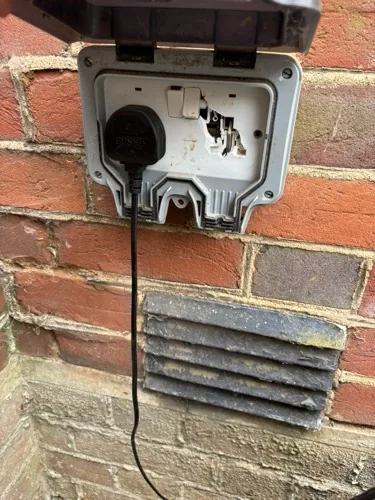
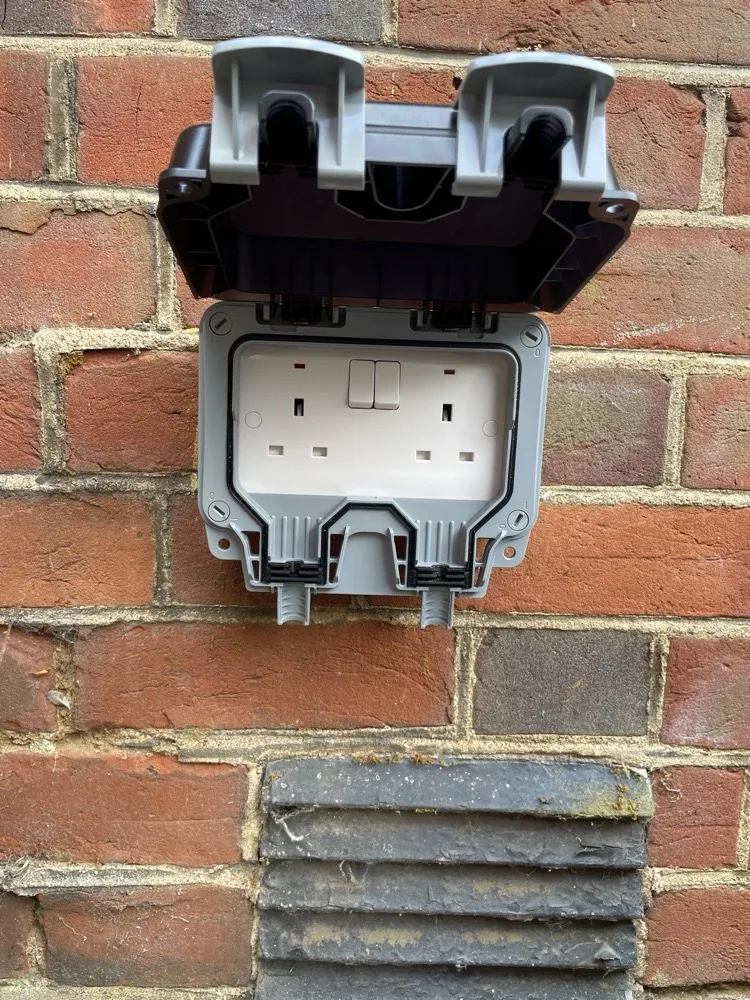
A melted outdoor socket in Harpenden, May 2025
A homeowner called us about an outdoor double socket that had melted. It had been powering a hot tub, and when Luke and Ryan arrived the plug top was burnt and rusted as well as the socket. We replaced both with a new weatherproof socket and a new plug top, tested the socket, and the hot tub was running again the same afternoon.
A hot tub draws a heavy load for hours and sits outside in the wet, which is hard on a 13A plug and socket. If you’re fitting one, a dedicated supply is the safer setup: see hot tub electrical installation and outdoor sockets.
Dehumidifiers and two scorched sockets in Stevenage, September 2024
After an earlier leak, a flat had two heavy-duty dehumidifiers running, one in a bedroom and one in the hallway, on different circuits. The power tripped. Matthew found heat damage at the live terminal of both sockets, and on the live pin of the dehumidifier’s plug. There was no water inside either socket, but one back box had come loose from the wall. He refixed it, replaced both sockets, tested them, and had the power back on within two hours of arriving.
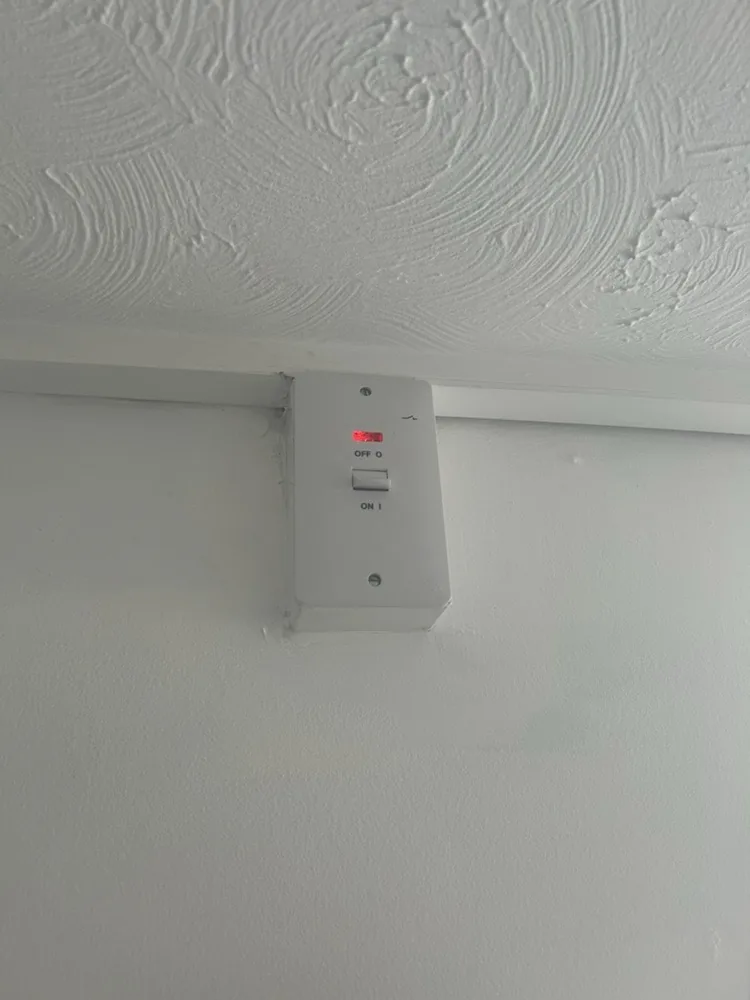
A shower isolator that burnt out in Leighton Buzzard, August 2025
In a retirement flat the shower had stopped working and the 45A shower switch on the ceiling wouldn’t switch. A loose connection inside it had overheated and burnt it out. Aidan arrived just after 8am, replaced the isolator, and the shower was working again before 9am. Showers draw far more than a socket, so a loose connection there heats up fast: see electric shower not working.
In the retirement flats we look after, burnt connections at immersion heaters are another regular find. If your hot water has stopped and there’s a smell near the cylinder, see immersion heater not working.
What to do
- Fire or smoke: get out and call 999.
- Switch off and unplug. Use the socket switch if it’s safe to touch. If the faceplate is hot, smoking or crackling, switch off the main switch on the fuse board instead.
- Don’t use it again, and don’t move the appliance to the socket next door. If the appliance or its plug is damaged, stop using that too.
- Don’t open it up. Taking the faceplate off a socket that has been overheating exposes live parts.
- Take a photo of the marks, the plug and what was plugged in. It helps us bring the right parts.
- Call us. We’ll find the cause, not just swap the socket: check the connections, the rest of the circuit and the load, and test before we leave.
If you’re finding scorch marks in more than one place, or the house still has old fittings, an electrical safety check (EICR) will find the other weak points before they fail. See also plug socket not working, no power or half the house off and emergency electrician in St Albans.
Questions we’re asked
Is it normal for a socket to spark when you plug something in?
A tiny, quick blue flash when plugging in or unplugging with the socket and appliance switched on can happen. A large, orange or yellow spark, a bang, a smell, smoke or black marks is not normal: switch off, unplug and have it checked.
Why does my plug socket smell of burning?
Usually a loose connection behind the socket or inside the plug is overheating under load, or the socket is being overloaded by a heater, dryer or extension lead. Overheating plastic can smell fishy rather than smoky. Switch off, unplug and don't use it until it's checked.
My plug socket is hot to the touch. Is that dangerous?
Slightly warm with a heavy appliance running can be normal. Too hot to keep your hand on is not: it means a poor connection or too much load. Switch off and unplug, and have the socket and plug checked.
Why is my socket buzzing or crackling?
Buzzing or crackling is arcing: electricity jumping across a poor connection. It produces heat and can start a fire. Switch it off, unplug everything from it and call an electrician.
Why did the plug on my washing machine melt?
Washing machines and tumble dryers draw close to 13A for long periods and vibrate, which loosens worn plugs and sockets. A melted plug usually means a poor connection at the plug, the socket or both. Replace both, and have the socket's connections checked.
Can I keep using a socket with scorch marks?
No. Scorch marks mean it has already overheated. Switch it off, don't plug anything else into it, and have it replaced and the circuit checked.
How quickly can you come out?
Monday to Friday, 8am to 5pm, an engineer is on site within one hour in St Albans and the surrounding towns. Phones are answered 7am to 10pm, seven days a week; outside the one-hour hours we'll tell you honestly when we can get to you.
Written by SEGplc. Last updated 21 October 2026.
Need it done by a date?
Tell us the deadline. We’ll tell you honestly whether we can hit it — and we usually can.