

- Home
- Plug socket not working
Plug socket not working? What to check, and when to call us.
The five-minute checks you can do safely, what it means when several sockets go dead at once, and the signs that need an electrician the same day.
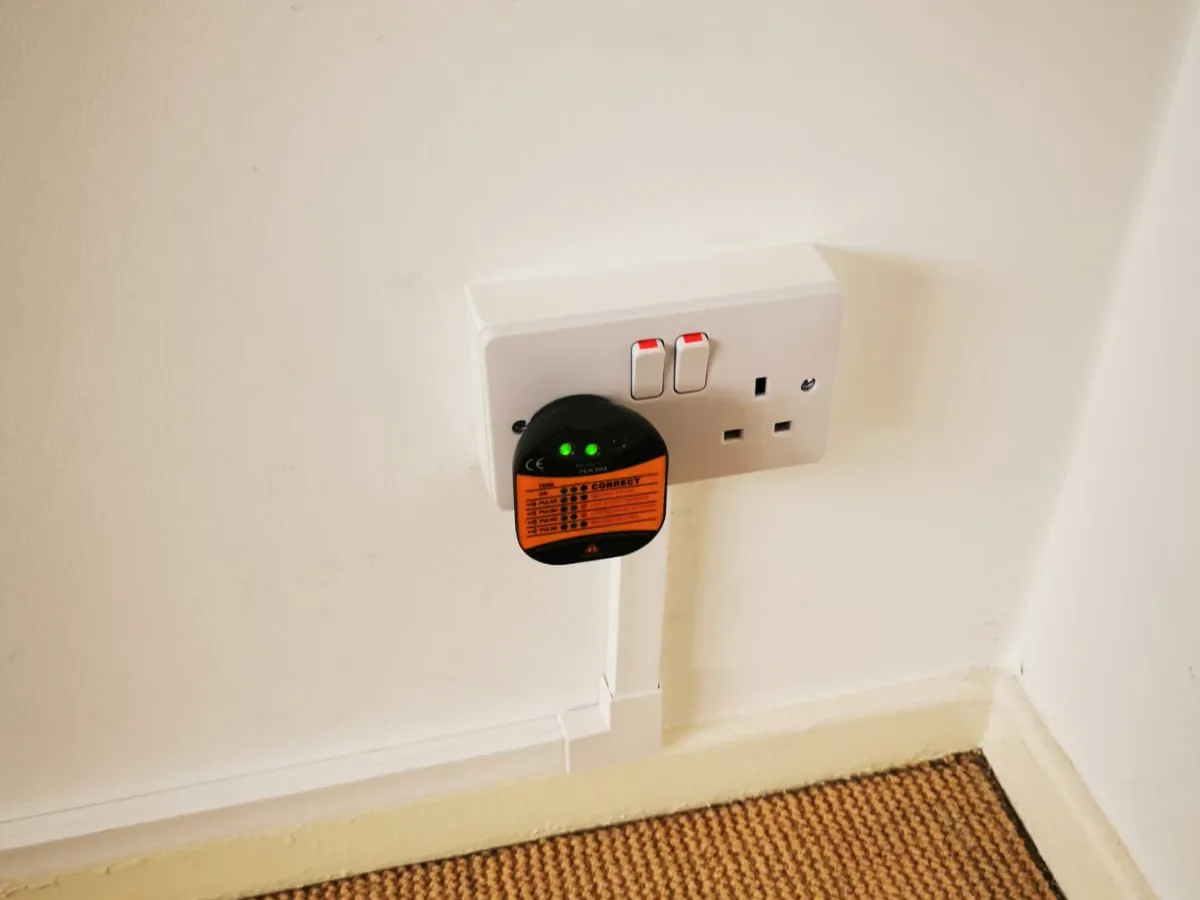
A plug socket that suddenly stops working is one of the most common calls we get. Often it is something you can sort in five minutes, safely, without touching any wiring. Sometimes it is a warning of a loose or burnt connection inside the wall, and that is a job for an electrician. Here is how to tell the difference.
1. Is it the socket or the appliance?
- Check the switch. Obvious, but sockets get knocked off by vacuum cleaners and furniture.
- Try something you know works, such as a phone charger or lamp, in the same socket.
- Try the appliance in another socket. If it works elsewhere, the socket is the problem. If it doesn’t work anywhere, it is the appliance or its plug fuse.
- Check any extension lead or adaptor. They fail far more often than sockets, and many have their own switch, fuse or reset button.
2. Check the fuse board
Open the fuse board (consumer unit) and look for a switch that is down or in the middle position. If a circuit breaker or RCD has tripped:
- Unplug everything on the sockets that went off.
- Switch the breaker or RCD back on.
- Plug things back in one at a time. If one trips it again, that appliance is faulty; leave it unplugged.
- If it trips straight away with nothing plugged in, leave it off and call an electrician.
Not sure what has tripped? Our guide RCD keeps tripping? explains the switches on your board and what each one means.
3. Check the fuse in the plug
UK plugs have a fuse inside. If an appliance works on nothing, its plug fuse may have blown. Replace it with the same rating, which is normally printed on the appliance or in its manual: usually 3A for lamps and small items up to about 700 watts, and 13A for kettles, heaters and anything bigger. Never fit a bigger fuse than the appliance needs, and if a new fuse blows straight away, the appliance has a fault.
Fixed appliances such as a cooker hood, boiler or towel rail are often fed from a fused spur, a switched or unswitched plate with a small fuse holder. If that fuse has blown, replace it with the same rating; if it blows again, call us.
4. Several sockets dead and nothing has tripped?
This one needs care. Most sockets in UK homes are wired on a ring: a loop of cable that starts and finishes at the fuse board. If a connection works loose at one socket, the sockets beyond it can lose power while the breaker stays on. A loose connection can overheat, so:
- Stop using those sockets.
- Look for scorch marks, discoloured plastic or a warm faceplate, but don’t take anything apart.
- Call an electrician. We’ll find the failed connection and test the whole circuit, so the problem doesn’t move to the next socket.
| What you see | Likely cause | What to do |
|---|---|---|
| One socket dead, others fine | Failed socket or loose connection behind it | Stop using it; call an electrician |
| Several sockets dead, breaker on | Broken or loose connection on the ring | Stop using them; call an electrician |
| Breaker or RCD tripped | Faulty appliance, damp or damaged cable | Unplug, reset, test one at a time |
| Appliance dead everywhere | Blown plug fuse or faulty appliance | Replace the plug fuse with the right rating |
| Socket hot, buzzing or scorched | Overheating connection | Switch off at the board; call us now |
When to call an electrician
- Any scorching, melting, burning smell, crackling or a socket that feels warm.
- A breaker or RCD that trips straight away with nothing plugged in.
- Several sockets dead and nothing tripped.
- A cracked or loose socket, or one hanging off the wall.
- Water near sockets, or an outside socket that trips when it rains.
- You are a landlord and a tenant has reported it. You must keep the installation safe; see electricians for landlords.
What we do on a visit
Our engineers are employed, NICEIC-approved electricians. We trace the fault with test equipment rather than swapping parts until something works. On most socket faults we:
- Isolate the circuit and make it safe.
- Find the failed socket or connection and replace damaged parts.
- Test the whole circuit (continuity of the ring, insulation resistance, polarity and earth fault loop) so we know it is right, not just working.
- Tell you in plain English what we found, and quote before any extra work.
If we find old or damaged wiring, we’ll say so. An EICR checks the whole installation, and our guide does my house need rewiring? explains the warning signs.
Socket problems: questions we’re asked
Why has my plug socket suddenly stopped working?
The most common reasons are a tripped circuit breaker or RCD at the fuse board, a blown fuse in the plug, or a fault in the appliance itself. If several sockets have stopped at once and nothing has tripped, it is usually a loose connection somewhere on the circuit, which needs an electrician.
Why are some sockets working and others not?
Sockets are wired in groups called circuits. If one group has gone off, check the fuse board for a switch that is down. If nothing has tripped and only some sockets on a circuit are dead, a connection has usually worked loose or burnt out at one of the sockets. That can get hot, so leave those sockets alone and call an electrician.
One side of my double socket doesn’t work. Why?
Check the switch on that side first, and try a plug you know works. If one side still does nothing, the socket has failed inside. It is a cheap part, but it should be replaced by an electrician, who will also check the connections behind it.
My kitchen sockets for the washing machine and dishwasher don’t work. What should I check?
Many kitchens have a row of switches above the worktop that control the appliance sockets hidden behind the units. Make sure the right one is on. Some appliances are fed from a fused spur with its own fuse; if that fuse has blown, the appliance may have a fault.
Can I replace a socket myself?
Replacing a damaged socket like for like is not notifiable under Part P of the Building Regulations, but it is still work on live wiring. If you are not competent, use a registered electrician. Adding new sockets or circuits in a kitchen, bathroom or outside often needs to be certified.
How much does it cost to fix a socket that isn’t working?
Most single-socket faults are fixed on the first visit. We quote before we start any repair, and if the fault turns out to be wider, such as a damaged cable or an old installation, we explain what we found and what it will cost.
My outside socket isn’t working. Is that normal?
Outside sockets are usually protected by an RCD, which trips if water gets in. Check the fuse board, and check the socket cover is closed and not cracked. If it trips again when it rains, water is getting in and the socket needs replacing.
Written by SEGplc. Last updated 19 October 2026.
Need it done by a date?
Tell us the deadline. We’ll tell you honestly whether we can hit it — and we usually can.