

- Home
- Emergency lighting testing
Emergency lighting testing and certificates.
What the monthly and annual tests involve, which certificates you need, and what a fire officer will ask to see. Tested and certified across Hertfordshire.
Tell us the type of building and roughly how many fittings. Call 0345 3 822 833 or email hello@segplc.com.
Emergency lighting only matters on the day the power fails, which is why it is so easy to forget about until a fire officer, insurer or auditor asks for the paperwork. This guide explains which tests are needed, what the certificates are, and what to expect when we test your system. If you need new or replacement lighting, see emergency lighting installation.
What the law says
In most non-domestic buildings, and the shared parts of blocks of flats, the responsible person under the Regulatory Reform (Fire Safety) Order 2005 must make sure that emergency routes and exits that need lighting have emergency lighting of adequate intensity if the normal lighting fails (article 14). Article 17 then requires that fire safety equipment, emergency lighting included, is subject to a suitable system of maintenance and kept in efficient working order.
The Order does not say how to test. That detail comes from BS 5266-1, the British Standard for emergency lighting, fully revised in 2025, and from your fire risk assessment.
The tests, and how often
| Test | How often | What happens | Who can do it |
|---|---|---|---|
| Function test | Monthly | Each fitting is switched to battery for a short time to check it lights, then switched back | A trained member of staff, or us |
| Full duration test | Yearly | The lights run on battery for their full rated duration, usually three hours, and every fitting is checked at the end | A competent electrical contractor |
| Inspection | With the annual test | Fittings, signs and wiring are checked for damage, and coverage is checked against the escape routes | A competent electrical contractor |
Based on BS 5266-1. Your fire risk assessment can set a stricter regime.
Some systems test themselves and report faults automatically. They still need the annual inspection, and someone has to read the reports and act on them.
Emergency lighting certificates, explained
When people ask for an “emergency lighting certificate”, they usually mean one of three documents:
- Completion (commissioning) certificate: issued when a system is installed or altered. It confirms the design, installation and commissioning meet BS 5266-1, and comes with a drawing showing where the fittings are.
- Periodic inspection and test certificate: issued after the annual full duration test. It records the date, the results, any fittings that failed and what was done about them.
- Logbook: the running record of every monthly test, every annual test, every fault and every repair. This is what a fire officer will ask to see first.
If you have taken over a building with no paperwork, we can survey the system, run a full duration test and start a fresh logbook and certificate from there.
What happens on the annual test
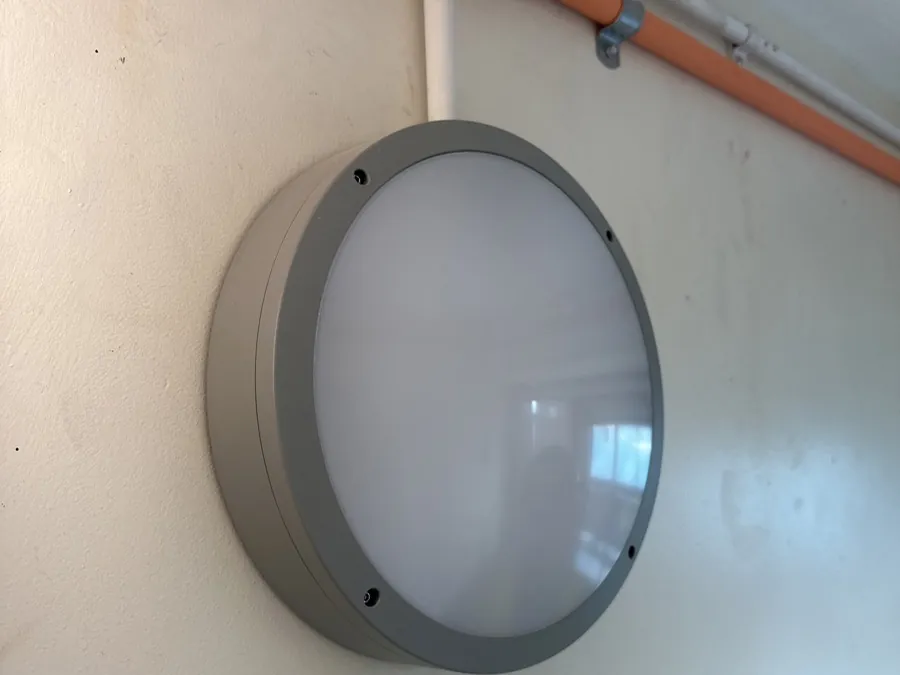
- Before: we agree a time when the building is quiet, or split the test so alternate fittings are tested, because batteries can take up to a day to recharge afterwards.
- On the day: we switch the emergency lighting circuits to battery and leave them for the full rated duration.
- At the end: we walk every escape route and check each fitting is still lit, and inspect fittings, exit signs and wiring for damage.
- After: the circuits go back to mains, we record every result, and you get the certificate, the logbook entry and a list of any failed fittings with a quote to put them right.
What commonly fails
- Batteries at the end of their life: the fitting lights on test but goes out long before the end of the rated duration
- Failed lamps or LED drivers
- Damaged or missing fittings and exit signs, often after redecoration or a fit-out
- Changes to the building: new partitions, a moved exit or a new stairwell that the original design never covered
- Gaps in the logbook: tests that were done but never written down count for nothing in an inspection
Servicing and maintenance contracts
Most of our customers have us carry out the annual test and repairs, and either do the monthly checks themselves or add them to the contract. Emergency lighting can sit in one maintenance contract alongside fire alarm servicing, fixed wire testing and PAT testing, with one schedule and one set of records kept in SEG Command, our own platform.
For an example, see our emergency lighting case study for housing blocks in Stevenage. We also test schools under a school maintenance contract, and communal areas for landlords and housing providers.
Emergency lighting testing across Hertfordshire
Our engineers start from SEG House in Chiswell Green, St Albans. We test emergency lighting in St Albans, Hemel Hempstead, Watford, Harpenden, Hatfield, Welwyn Garden City, Hertford, Stevenage, Potters Bar, Radlett, Rickmansworth and Borehamwood, and across Bedfordshire, Buckinghamshire and London.
Emergency lighting testing questions we’re asked
Do I need an emergency lighting certificate?
If your building has emergency lighting, you should be able to show it is installed and maintained properly. That means a certificate when it is installed or altered, a periodic inspection and test certificate after the annual test, and a logbook of the monthly tests. A fire officer, insurer or fire risk assessor will usually ask to see them.
How often should emergency lighting be tested?
Under BS 5266-1, a short function test of every fitting each month, and a full rated-duration test once a year. Both are recorded in the logbook. Your fire risk assessment may ask for more.
Can we do the monthly test ourselves?
Yes. The monthly function test is simple enough for a trained member of staff: switch the fittings to battery with the test key, check each one lights, and record it. Many of our customers do the monthly checks themselves and use us for the annual test and repairs.
How long does the annual test take?
As long as the system’s rated duration, usually three hours, plus time to inspect every fitting and record the results. Afterwards the batteries need time to recharge, so we plan the test for when the building is quiet or test alternate fittings.
Does emergency lighting need to last three hours?
Three hours is required for sleeping accommodation, such as hotels, care homes and blocks of flats, and is the usual choice elsewhere. A shorter duration is only acceptable where the fire risk assessment supports it.
What happens if a fitting fails?
We mark it on the test record, tell you which fitting failed and why, and quote the repair. Most failures are batteries at the end of their life, failed lamps or damaged fittings, and the same engineers can replace them.
Who is responsible for emergency lighting?
The responsible person under the Regulatory Reform (Fire Safety) Order 2005: usually the employer, owner, landlord or managing agent. In blocks of flats this covers the shared parts, such as stairs and corridors.
Sources
- legislation.gov.uk, Regulatory Reform (Fire Safety) Order 2005, article 14 and article 17
- BSI, BS 5266-1:2025 Emergency lighting. Code of practice for the emergency lighting of premises
Written by SEG. Last updated 17 October 2026.
Need it done by a date?
Tell us the deadline. We’ll tell you honestly whether we can hit it — and we usually can.