

Open · 7 days, 7am–10pmHead office St Albans · Herts · Beds · Bucks · London
  1. Home
  2. Battery storage

Be ready for a three-day power cut. A home battery, no solar needed.

The government’s Be Ready campaign asks every household to plan for three days without power. A home battery keeps the fridge, boiler, lights and Wi-Fi on, and saves you money the rest of the year.
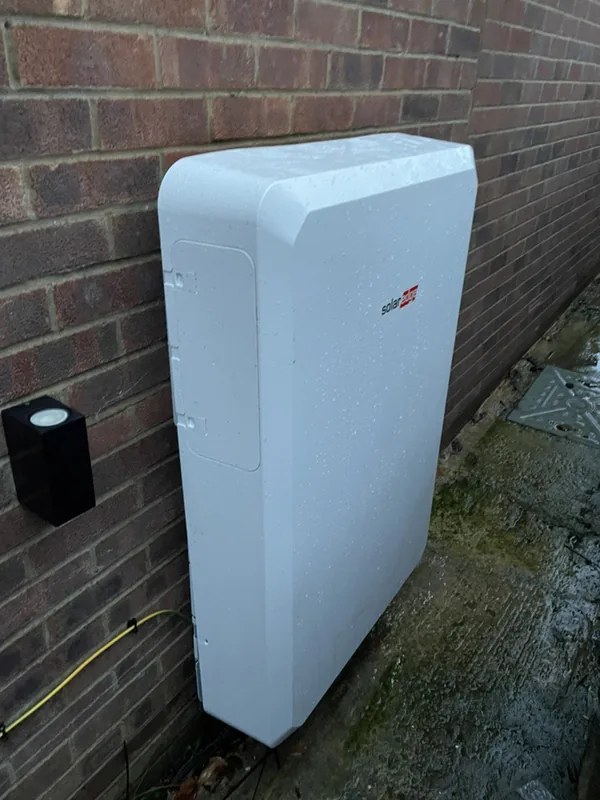
SolarEdge home battery fitted on an outside wall by SEG
Why now? On 22 October 2026 the government launched its Be Ready campaign, asking every household to be ready for three days without power, water, phones or the internet. The same week, Storms Austen and Boelo cut power to hundreds of thousands of homes: the Energy Networks Association said almost 350,000 customers had been reconnected by the Sunday morning, with more than 82,000 still waiting.

The checklist covers water, tinned food, a torch and a power bank. A home battery covers the bit a power bank can’t: the fridge and freezer, the boiler, the lights, the Wi-Fi. And for the rest of the year it pays its way by storing cheap overnight electricity for you to use at the expensive times of day.

You don’t need solar panels

A battery is a separate piece of kit. It charges from the grid overnight on a cheaper tariff, or from solar panels if you have them or add them later. Plenty of homes can’t have solar: a shaded or north-facing roof, a flat, a listed building, a conservation area. A battery still works for all of them. It usually goes in the garage, a utility room or on an outside wall, near the fuse board.
SolarEdge home battery fixed to an outside brick wall
A SolarEdge battery we fitted on an outside wall. It’s weatherproof, so it doesn’t take up room indoors.
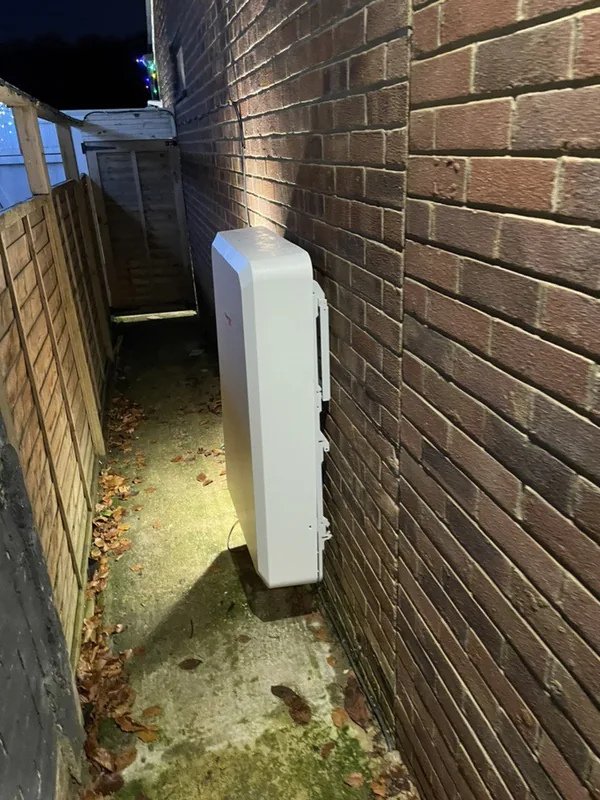
Home battery on the wall of a narrow side passage at night
The same battery in the side passage. A side or back wall near the fuse board is often the best spot.
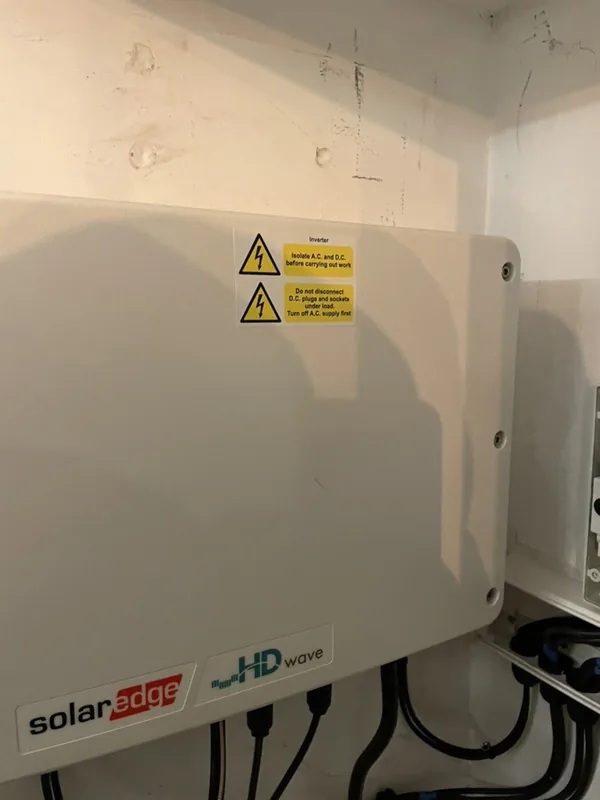
SolarEdge HD-Wave inverter on a garage wall with labelled isolators
The inverter in the garage, labelled and ready for the network operator’s paperwork.

Will it keep the lights on in a power cut?

Only if it’s set up to. This is the question to ask any installer. When the grid goes off, a battery has to disconnect your home from the network (so it isn’t feeding power back to engineers working on the cables) before it can power anything. Many systems sold on price simply switch off with the grid. To keep running, a system needs a backup unit or gateway that does that switch-over automatically, usually within a few seconds.

  • Essential circuits backup: the fridge and freezer, the boiler, lights, the router and a few sockets are wired to a backed-up board. Lower cost, and the battery lasts longer.
  • Whole-house backup: everything stays on, within what the battery and inverter can deliver at once. Costs more and drains the battery faster.

We’ll tell you which suits your home and quote for it in writing, so you know exactly what stays on.

How big a battery for three days?

Rough figures for a typical home running only the essentials (yours will differ, and the survey sizes on your own usage):

  • Fridge-freezer: about 1 kWh a day
  • Gas boiler and heating pump (it needs electricity to run): about 1 kWh a day in winter
  • LED lights in the rooms you’re using: about 0.5 kWh a day
  • Broadband router, phones and a laptop: about 0.5 kWh a day

That’s roughly 3 kWh a day, or 9 to 10 kWh for three days. Without solar, the battery can’t recharge until the power comes back, so size for the whole stretch. Electric showers, ovens, kettles and electric heating use far more, and are usually left off the backed-up circuits.

Home batteries compared, cheapest first

If you are choosing a battery because of the Be Ready advice, the row that matters most is power cut backup: whether the battery keeps your home running when the grid goes off, and what extra equipment that needs. Here are six popular batteries side by side. The four we fit are marked. For the others, ask us: some need a specific approved installer.

BatteryCostUsable sizePower cut backupWarrantyGood to know
AlphaESS SMILE G3
Ask us
£4.56 or 9.3 kWh per moduleBackup port for chosen circuits; switch-over of 20 milliseconds or faster is quoted10 years, 80% at year tenHybrid or AC-coupled. Check the warranty terms: some depend on the battery staying online. Budget choice.
Fox ESS EVO We fit£About 9.7 kWhBackup port for selected circuits included; whole-house needs an extra backup box12 yearsBattery and inverter in one outdoor-rated unit, with a 5, 8 or 10 kW inverter. Good value for its size.
Tesla Powerwall 3 We fit££13.5 kWhWhole or part of the home, with Tesla’s Backup Gateway10 years, 80% at year tenBuilt-in inverter up to 11 kW. The biggest single unit here, so the highest total cost. Needs a Tesla-certified installer.
Sigenergy SigenStor We fit££5.2 or 7.8 kWh per module, stackableWhole-home with the Sigen Gateway (an extra)10 years, 70% at year ten (or a throughput limit)Inverter, battery and, if you want it, an EV charger in one stack. Grows by adding modules.
Enphase IQ Battery 5P
Ask us
££5 kWh per unit, stackableWith the Enphase IQ System Controller15 years or 6,000 cyclesAC-coupled, so it suits homes that already have Enphase solar. Small units, so a three-day target needs two.
SolarEdge Home Battery We fit£££9.7 kWhBackup is available with SolarEdge’s backup equipment; we confirm what stays on at survey10 years, 70% at year tenDC-coupled and designed to pair with a SolarEdge inverter. The battery alone sits at the top end; the installed price is not published.

£, ££ and £££ rank these six by fitted cost for each kWh of storage: £ is the cheapest. A bigger battery costs more in total, so a Powerwall can cost more than a smaller unit even where its cost per kWh is lower. We show bands, not prices, because prices change often and differ between sellers. Figures are the makers’ published specifications and public price roundups, checked November 2026, so treat them as a guide. Sources: Home Energy Quotes, Solar Grid Check, Heatable.

How to choose for a power cut

  • Ask what backup costs. On several of these the backup unit or gateway is an extra, often around £1,000 fitted. Make sure it is in the quote.
  • Match the size to the three days. About 9 to 10 kWh covers the essentials (see above). Two 5 kWh units or one 9 to 13 kWh unit both get there.
  • Already have solar? Some batteries work best with a matching inverter (SolarEdge with SolarEdge, Enphase with Enphase). We check this at survey.
  • Check the warranty small print. Years matter less than the capacity it must keep and whether it depends on staying online.

Not sure which is right? Fill in the battery survey and we will recommend one and quote it in writing.

0% VAT until 31 March 2027

A battery added to an existing home is currently zero-rated for VAT, whether or not you have solar panels. That relief is set to end on 31 March 2027, so a system fitted before then avoids the VAT.

How it works with us

  1. Tell us about your home. The battery survey below, a call, or an email. Photos of where it could go and your fuse board help most.
  2. Survey and sizing. We look at your usage, your tariff, your fuse board and where the battery can go, and agree which circuits are backed up.
  3. A fixed, written quote. Battery, backup unit, installation and any fuse board work, itemised.
  4. Installation by our own engineers. Usually one day. We notify the network operator for you (UK Power Networks in Hertfordshire and London) and certify the work.
  5. We test a power cut before we leave. We switch off the supply and show you what stays on, and set up the app so you can see the battery’s charge.

We fit systems such as Sigenergy, SolarEdge, Fox ESS and Tesla Powerwall, and can add solar panels or an EV charger now or later. See solar PV and battery storage.

While you’re getting ready

Want to know what a battery would cost for your home? Fill in the battery survey at the bottom of this page: a few questions and photos of where the battery could go, your fuse board and your meter. We’ll come back with a fixed price. Or call 01727 238 999.
Older house? See is a 60 amp main fuse enough: for a battery, charger or heat pump.

Questions we’re asked

Can I have a home battery without solar panels?

Yes. A battery charges from the grid, usually overnight on a cheaper tariff, and you use that stored electricity during the day and in a power cut. You can add solar panels later and the battery will store their power too.

Does every home battery work during a power cut?

No. Many systems switch off when the grid goes down. To keep power on, the system needs a backup unit or gateway that disconnects your home from the network and switches over automatically. Ask any installer this before you buy.

How big a battery do I need to get through three days?

Running only the essentials (fridge-freezer, gas boiler, lights, router and phones) a typical home uses roughly 3 kWh a day, so about 9 to 10 kWh for three days. We size it on your own usage at the survey.

Will my gas boiler work in a power cut?

Not without electricity. The boiler's controls and the heating pump need power. If the boiler is on a backed-up circuit, a battery keeps your heating and hot water running.

Is there VAT on a home battery?

A battery retrofitted to an existing home is currently zero-rated for VAT, with or without solar panels. That relief is set to end on 31 March 2027.

Do I need permission to fit a battery?

Not planning permission in most cases, but the network operator must be told. We handle that notification for you as part of the installation.

Can I add more batteries to my existing system?

Often, yes. Most modular systems take extra battery modules up to a limit set by the inverter or battery controller, so a 10 kWh system can usually grow to 15 or 20 kWh with the same brand. We check the model, the loft or cupboard space and the weight, then quote for the extra modules and the network notification.

Written by SEGplc. Last updated 4 November 2026.

Battery survey: send us the details and photos

About five minutes on your phone. Tell us about your home, then add photos of where the battery could go, your fuse board and your electricity meter. We do a desktop survey and come back with a fixed, written price, usually without a first visit. Skip anything you’re not sure about.

1About you and the property

How much detail would you like to give? Quick takes about 2 minutes. Detailed takes about 5 and lets us give a more accurate price. You can switch at any time and nothing you have typed is lost.

Survey lengthChoose one
Are you the owner of the property?Choose one
We will need to speak to the owner before we quote, because the paperwork is in their name.
Type of propertyChoose one
Is it listed or in a conservation area?Choose one
2What do you need?

Tick everything that applies. The questions below change to match.

3Electricity use
What we need from your bills. Your annual electricity use in kWh — that is what sizes the system. The quickest way is your annual statement, or any recent bill that shows Annual consumption or Estimated annual usage. If you cannot find that, the last 12 months of bills, or a screenshot of the usage page in your supplier’s app, does the same job. Your tariff (for example Economy 7 or an EV tariff) also changes how much a battery saves.
Do you have a smart meter?Choose one
Is someone usually at home during the day?Choose one
Do you have, or plan to get, any of these?Tick all that apply
4Solar panels and battery

We check which way the roof faces and its size from our design software, so you do not need to.

What is the roof covered with?Choose one
Are there tall trees close to the house?Choose one
Would you like battery storage?Choose one
Is backup power during a power cut important?Choose one
Where could the inverter and battery go?Tick all that apply
Anything else you would like?Tick all that apply

Equipment

How would you like us to quote?Choose one
Any panel brand in mind?Tick all that apply
Any inverter or battery brand in mind?Tick all that apply

Scaffolding and access

Is there clear access around the house for scaffolding?Choose one
Anything in the way where scaffolding would go?Tick all that apply
Is there parking for our vans and the scaffold lorry?Choose one
Who will arrange the scaffolding?Choose one
4Home battery

You don’t need solar panels for a battery. These answers, and a photo of where it could go, let us size it and price it, usually without a first visit.

Do you have solar panels?Choose one
What do you want the battery for?Tick all that apply
In a power cut, what would you want kept on?Choose one
How is your home heated?Choose one
A boiler needs electricity to run, so it is usually on the backed-up circuits.
Where could the battery go?Tick all that apply
A photo of each spot in the Photos section helps most. We check it meets the fire-safety rules: a battery can’t go in a bedroom or on an escape route such as the hall or stairs.
Any battery brand in mind?Tick all that apply
5EV charger
Where would the car be charged?Choose one
Do you already have solar panels?Choose one
Is your electricity supply single-phase or three-phase?Choose one
Look at the sealed fuses next to your meter. Don't remove any covers.
Do you want a tethered or an untethered charger?Choose one
Tethered is like a petrol pump: the cable is attached, so you plug it straight into the car. Untethered has a socket for your own cable, which is tidier and suits more than one car.
Which charger would you like?Choose one
See our top 11 home EV chargers, or use the picker there to compare them cheapest first.
6Your fuse board
A fuse board (consumer unit) with the cover closed and four spare ways labelled SPARE
What we are looking for. This is a fuse board (consumer unit) with the cover closed. A spare way is an empty slot with no switch in it, usually a blank plate — on this board, the four on the left labelled SPARE. Solar, batteries, EV chargers and air conditioning each need their own way, so this tells us whether the board can take them or needs upgrading. A photo tells us most of this at a glance: add one just below.
Is there a spare way on the fuse board?Choose one
What do the switches look like?Choose one
Where is the fuse board?Choose one
Main fuse size, if you can see itChoose one
Printed on the sealed fuse next to the meter. Don't remove any covers.
6Your wiring
What is the EICR for?Choose one
Will the property be lived in during the work?Choose one
6Your current maintenance contract

Upload your current contract or schedule and we will review it. If we can give you better value or better cover, we will quote to beat it. If we can’t, we will tell you.

One contract can cover it all: electrical repairs and testing, EICRs, PAT testing, emergency lighting, fire alarms, CCTV, access control and door entry, intruder alarms, data networks and Wi-Fi, school bells and PA, vape detectors and lockdown alerts. Tick what your current contract covers below, and tell us anything else you want included.

What type of premises?Tick all that apply
What does it cover now?Tick all that apply
Anything you would like to be better?Tick all that apply
6Air conditioning
What style of indoor unit would you like?Tick all that apply
Wall-mounted is the usual choice and what we recommend for almost every home: a slim unit high on the wall, simplest to fit and best value. Ceiling cassette: a square panel set into the ceiling that blows air four ways; needs space above the ceiling. Ducted: the unit is hidden in the ceiling space with small grilles, so you see no unit at all; best for a new build or full refurbishment. Floor-standing: a low unit near the floor, for rooms with no high wall space.
See what each style looks like
Wall-mounted
A slim unit high on the wall
Ceiling cassette
A square panel set into the ceiling
Ducted
Hidden above the ceiling, only small grilles show
Floor-standing
A low unit against the wall near the floor

Simple drawings to show the idea, not to scale.

Any Daikin look in mind? Most people leave this to us: we recommend the best-value range for your rooms, and the one we usually fit is Comfora. Choose one below only if you have seen one you like.

Compare the Daikin ranges with pictures
★ SEG choice

Product images: Daikin (from daikin.co.uk). All rights in the images belong to Daikin. The ranges are listed cheapest first. The ★ SEG choice is the range we have been installing. The £ signs show how they compare on cost, from £ good value to ££££ premium. They are not prices: we give a fixed price after the survey.

Tell us about each room. No measuring needed: just pick the closest description. Recently bought or sold? Add the floor plan from the Rightmove or Zoopla listing here. It lets us size every room without measuring.

Room 1

What are the outside walls like?Choose one
What are the windows?Choose one
Are any of these rooms directly under the roof?Choose one
Top-floor and loft rooms get hotter, so they can need a bigger unit.
Do you want heating as well as cooling?Choose one
Where could the outdoor unit go?Choose one
A photo of the spot helps most: add one just below.

Controls: every unit comes with a handheld remote. The home ranges can also be controlled from Daikin’s Onecta phone app over Wi-Fi, and with Alexa or Google Assistant. Tick that below if you want it: on some ranges the Wi-Fi is a small plug-in adaptor, which we confirm at survey.

Any optional extras?Tick all that apply
These are extras, priced at survey. Phone app control needs your home Wi-Fi to reach the room, which we check at survey. A wired wall controller sits on the wall like a room thermostat and suits a shop, office or rental. Links to smart-home and building systems are for bigger or commercial jobs. Tick as many as you like, or none.
Is your electricity supply single-phase or three-phase?Choose one
Look at the sealed fuses next to your meter: one fuse means single-phase, three fuses means three-phase. Larger Daikin units and some multi-splits depend on this.
6Your air conditioning

Tell us what you have and add a photo of each unit and its label. We use it to price your servicing without a first visit. Not sure about something? Skip it and we will check on the day.

What styles of indoor unit do you have?Tick all that apply
What kind of system is it?Choose one
Where are the outdoor units?Tick all that apply
Roughly where they are and how easy they are to reach

Photos help most. Stand back and photograph each outdoor unit, then the label on its side (make, model and serial number). Do the same for one of each style of indoor unit. If the label is hard to reach, a photo of the remote control shows the make.

Anything not right at the moment?Tick all that apply
How often would you like it serviced?Choose one
7Photos and documents

Photos save a lot of back and forth. The ones for your fuse board, the air-conditioning outdoor unit and each room are in the sections above, next to the questions they go with. Anything else you would like us to see goes here. We shrink photos before sending, so do not worry about size. One photo per box.

Rather send photos later?
8Anything else
Best way to reach youChoose one

Need it done by a date?

Tell us the deadline. We’ll tell you honestly whether we can hit it — and we usually can.

Contact

Talk to SEG

Questions about a job, a certificate or a programme of works? Call the office or send a message. Head office in St Albans, serving Herts, Beds, Bucks and London.

Emailhello@segplc.comPhone01727 238 999Also on0345 3 822 833OfficeSEG House, 192 Watford Road, Chiswell Green, St Albans, Herts AL2 3EBHours7 days, 7am–10pm · emergencies by arrangementLeadershipMichael Simm · Russell Solts
Call nowGet a quote