

- Home
- Sockets on a ring main
How many sockets on a ring main?
There is no set number. Here is what does limit a ring main, how spurs work, and how we add sockets safely.
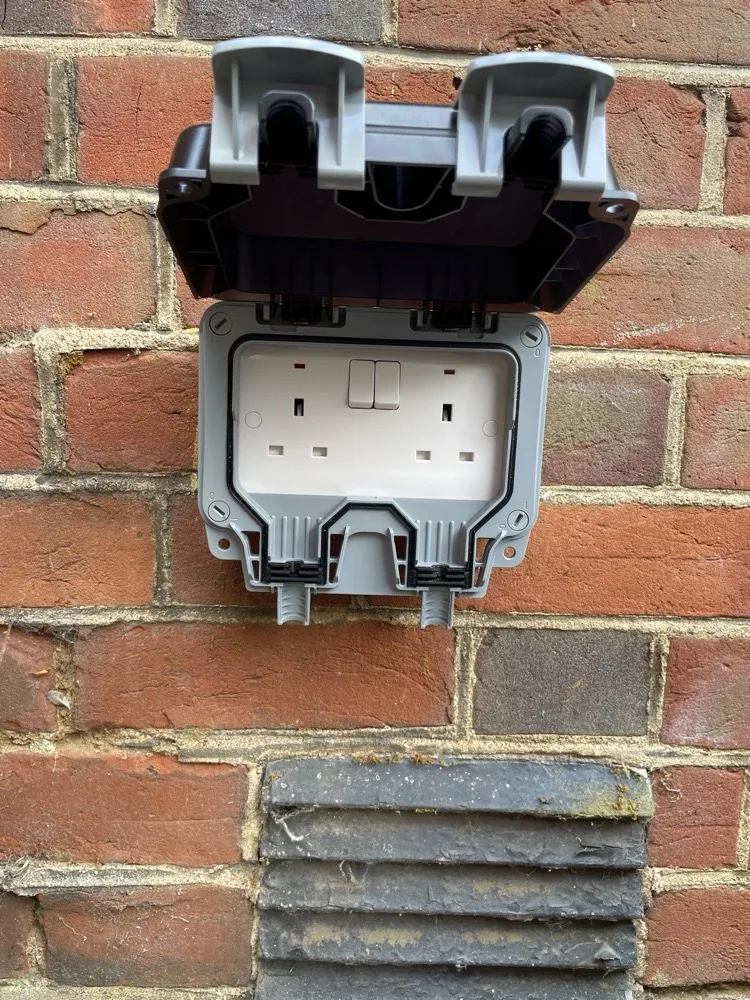
What is a ring main?
A ring main (properly a ring final circuit) is a loop of cable that starts at the fuse board, runs round a set of sockets and comes back to the same breaker. Because power can reach each socket from both directions, a ring can use thinner cable than a single run. Most UK homes have one or more rings for sockets, often one upstairs, one downstairs and one for the kitchen.
| Standard ring | |
|---|---|
| Breaker | 32 A (MCB or RCBO) |
| Cable | 2.5 mm² twin and earth |
| Floor area served | Up to 100 m² |
| Number of sockets | No fixed limit |
| Protection | 30 mA RCD for sockets (current regulations) |
What about spurs?
A spur is a branch off the ring to an extra socket. The rules from the wiring regulations’ guidance:
- An unfused spur can feed only one single or one double socket, or one fused connection unit.
- The number of unfused spurs shouldn’t be more than the number of sockets and fixed appliances on the ring itself.
- A fused spur (taken through a 13 A fused connection unit) can feed several sockets, because the fuse protects the smaller cable.
- You shouldn’t spur off a spur.
We often find the opposite on EICRs: spurs off spurs, rings broken into two radials by an old DIY job, or a ring that doesn’t join up at the board. They can work for years and still be unsafe, because the cable may not be protected properly by the breaker.
Kitchens
Kitchens have the heaviest loads: kettle, toaster, washing machine, dishwasher, tumble dryer. We usually put them on their own ring, with the cooker on a separate circuit, and large appliances on fused connection units so you can isolate them. If your kitchen breaker trips when two or three things are on, see RCD keeps tripping.
Can I add more sockets?
Usually, yes. We check the ring is a true ring first (continuity at the board), then either extend the ring, add a fused spur, or run a new circuit if the area or load is too much. A new circuit is notifiable work under Part P; we register it and give you a certificate. Adding a socket to an existing circuit isn’t notifiable, but it still needs testing.
We see these faults every week. Since summer 2025 our engineers have attended more than 2,700 repair call-outs in homes and flats across Herts, Beds, Bucks and London, around 630 of them for sockets and switches and over 900 for lighting.
Questions we’re asked
How many sockets can you have on a ring main?
There is no fixed limit. A standard 32 A ring final circuit in 2.5 mm² cable can serve a floor area of up to 100 m², with as many sockets as that area needs.
How many spurs can you have on a ring main?
The number of unfused spurs shouldn't be more than the number of sockets and fixed appliances on the ring. Each unfused spur can feed one single or one double socket, or one fused connection unit.
Can you spur off a spur?
No. A spur should come from the ring itself, a socket on the ring, or a junction box on the ring. Spurring off a spur can overload the cable.
Should a kitchen have its own ring main?
We recommend it. Kitchens have the heaviest loads, so a separate ring, a separate cooker circuit and fused connection units for large appliances make tripping less likely.
Do I need an electrician to add a socket?
Adding a socket to an existing circuit isn't notifiable, but it must be done safely and tested. A new circuit is notifiable under Part P, so it needs a registered electrician like us.
Written by SEGplc. Last updated 1 November 2026.
Need it done by a date?
Tell us the deadline. We’ll tell you honestly whether we can hit it — and we usually can.