

- Home
- Charging from a 3-pin plug
Charging an electric car from a 3-pin plug
It works, it’s slow, and it’s only safe if you follow a few rules. Here they are.
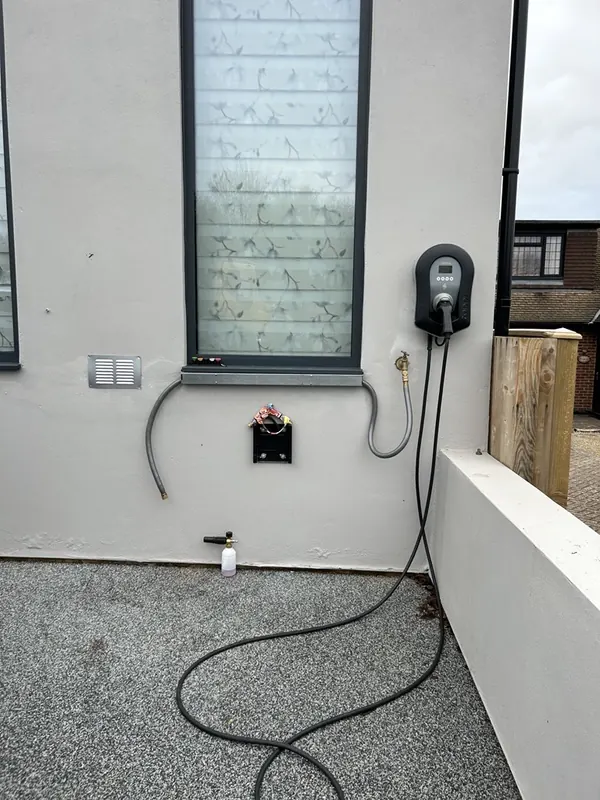
Most electric cars come with a cable that plugs into an ordinary 13 A socket, often called a granny charger. It works, and it is fine now and then. A customer in Barnet asked us whether she could use her garden socket until her wall charger arrived, and the honest answer is yes, carefully, and not for long.
How a 3-pin charger works
The box on the cable limits the car to about 10 A, roughly 2.3 kW, because a normal socket and its wiring are not designed to run flat out for hours. A dedicated home charge point runs at 7 kW on its own circuit from the fuse board, with its own protection.
How slow is it?
| 3-pin plug (2.3 kW) | Home charge point (7 kW) | |
|---|---|---|
| Range added per hour | About 8 to 10 miles | About 25 to 30 miles |
| Empty to full, 60 kWh battery | More than 24 hours | About 8 to 10 hours |
| Typical daily commute (30 miles) | 3 to 4 hours | About 1 hour |
Is it safe?
Electrical Safety First, the UK charity, strongly advises against charging from a 13 A socket on a regular basis, and says it should be kept for visiting friends or family who have no charge point. The reasons:
- A socket running at 10 A for ten hours gets warm. Old, loose or back-wired sockets get hot, and that is how plugs melt.
- Older homes often have the garage or garden socket spurred off a ring that already feeds the kitchen. Add the car and the breaker trips, or worse, nothing trips and the cable cooks.
- Extension leads are the biggest risk. Three in four EV owners admit to using one. Indoor leads, reeled leads and daisy-chained leads overheat.
If you are going to do it anyway
- Use a socket that is in good condition, ideally one on its own circuit, and check it is not warm after the first hour.
- Plug straight in. If you must use an extension lead, use one made for outdoor use, fully unwound, no longer than 15 m, rated at 13 A, and plugged into an RCD-protected socket. Never daisy-chain.
- Never run a cable across a pavement without a proper cable guard.
- Don’t run the tumble dryer, oven and car on the same circuit at the same time.
- Check the plug and cable for heat or damage every time.
The better option: a proper charge point
A wall charger is three times faster, runs on its own circuit with its own earth fault protection, and lets you charge on a cheap overnight tariff, which is where the real saving is. Installed in a day. See home EV charger installation, which charger to choose and the Zappi if you have solar.
If a 13 A socket is your only option for a while, we can fit a dedicated outdoor socket on its own circuit with RCD protection, which removes most of the risk. It costs a fraction of a charge point and is still useful afterwards.
Questions we’re asked
Can I charge my electric car from a normal plug socket?
Yes, with the cable supplied with the car, at about 2.3 kW. It is fine occasionally. Electrical Safety First advises against doing it regularly, because sockets and house wiring are not designed to run at full load for hours.
How long does it take to charge an EV from a 3-pin plug?
Roughly 8 to 10 miles of range an hour. A 60 kWh battery takes more than 24 hours from empty, against 8 to 10 hours on a 7 kW home charger.
Can I use an extension lead to charge my car?
Avoid it. If you have no choice, use an outdoor-rated 13 A lead, fully unwound, no longer than 15 metres, plugged into an RCD-protected socket, and never daisy-chain. Indoor and reeled leads overheat.
Why does the socket get warm when I charge the car?
Ten amps for hours on end warms any socket. If it is hot to touch, the socket or its connections are failing. Stop charging and have it checked.
Is a granny charger cheaper than a home charger?
The cable is free with most cars, but you can't use a cheap overnight EV tariff properly at 2.3 kW, so most people end up paying more per mile. A charge point usually pays for itself within a couple of years.
Can you fit a dedicated socket for a granny charger?
Yes. A weatherproof 13 A socket on its own circuit with RCD protection is a quick job and much safer than a shared garage socket. Many customers have it as a stopgap and add a charge point later.
Written by SEGplc. Last updated 1 November 2026.
Need it done by a date?
Tell us the deadline. We’ll tell you honestly whether we can hit it — and we usually can.