

- Home
- EV charger, terraced house
EV charger for a terraced house
Fuse board at the front, parking at the back. How we get the cable there, and what it costs.
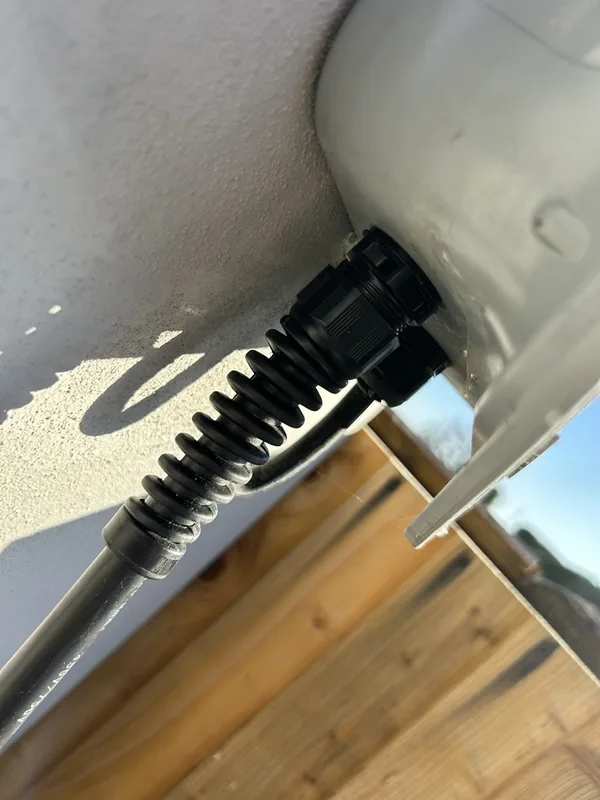
A St Albans customer in AL4 emailed us in October with the classic terraced-house problem: fuse board at the front of the house, parking space at the back, and a question about whether a charger in the back garden was even possible. It is, and the job has since been booked. This page is the answer we gave him.
Getting the cable from the front to the back
A 7 kW charger needs its own cable from the fuse board, usually 6 mm² or 10 mm² depending on length. In a terrace there are three ways to get it to the back:
| Route | How | Good for | Watch out for |
|---|---|---|---|
| Through the house | Clipped along the skirting, under floorboards, or through the loft and down the back wall | Most houses. Cheapest when the floors or loft are accessible | Solid floors and finished kitchens make it slow and messy |
| Round the outside | Armoured cable along the side wall or the party wall, or over the roof line in a conduit | End terraces and houses with a side passage | Mid-terraces have no side; you may need a neighbour’s permission for a party wall |
| Through the garden | Armoured cable buried in a trench, or clipped to a fence or wall | The last stretch from the house to a garage, carport or rear parking | Digging costs; a fence that gets replaced takes the cable with it |
Usually it is a mix: through the house to the back wall, then along the garden wall or in a trench to the charger. We use steel-wire-armoured cable outdoors and in the ground, which is what the wiring regulations expect.
What affects the price
- Cable length. A standard home installation allows for about 10 to 15 m of cable. A front-to-back run in a terrace is often 20 to 30 m, which adds cable and labour.
- Digging. A trench across a lawn is quick. Lifting and relaying a patio or a concrete path is not.
- Making good. We can chase the cable into walls and plaster over, or leave it in neat white trunking. Chasing costs more.
- The fuse board. If there is no spare way, or the board is old, it may need a small enclosure beside it or a replacement. See does my fuse board need replacing?
- The main fuse. Most terraces are fine; see is a 60 amp main fuse enough?
We price each option separately so you can choose. For the AL4 job above the through-the-house route was the practical one.
If you have no off-street parking at all
You cannot legally run a cable across the pavement without a cable guard, and the council may object even then. Some councils, including a growing number in Hertfordshire and London, allow a cross-pavement charging gully, a small channel set into the paving that the cable sits in. Households with only on-street parking who install one can claim the government grant of up to £500 towards the charge point. Ask us and we will check what your council allows.
The survey
For a terrace we usually want to see it, because the route decides the price. The survey is free, takes about 30 minutes and we can often do it the same week. If you would rather start with photos, the EV charger form asks for the fuse board, the meter, the parking spot and the route between them, and we can give a first price from that.
Questions we’re asked
Can I have an EV charger if my parking is at the back and the fuse board is at the front?
Yes. We run a dedicated cable through the house, round the outside or through the garden, and fit the charger where you park. It is a common job in terraced streets around St Albans and north London.
How long can the cable be from the fuse board to the charger?
There is no fixed limit; the cable is sized for the length so the charger still gets full power. Runs of 30 to 40 metres are routine. Longer runs use thicker cable, which costs a little more.
Do I need my neighbour's permission?
Only if the cable goes on or through the party wall or across their land. Running it inside your own house or along your own garden wall needs no permission.
Can the cable be buried in the garden?
Yes. Armoured cable in a trench, at a depth and with a marker tape as the wiring regulations expect. We dig and reinstate lawns ourselves; patios and concrete paths are priced separately.
Is there a grant for a charger in a terraced house?
If you own or rent a flat, or you have only on-street parking and install a cross-pavement solution, the government grant is up to £500. A house with its own parking space gets no grant.
Do you charge for the survey?
No. For terraced houses we prefer to visit because the cable route decides the price, and the survey is free.
Written by SEGplc. Last updated 1 November 2026.
Need it done by a date?
Tell us the deadline. We’ll tell you honestly whether we can hit it — and we usually can.