

- Home
- PAT testing London
PAT testing in London.
Offices, construction sites and landlords: every appliance inspected, tested, labelled and recorded, with a full report for your files.
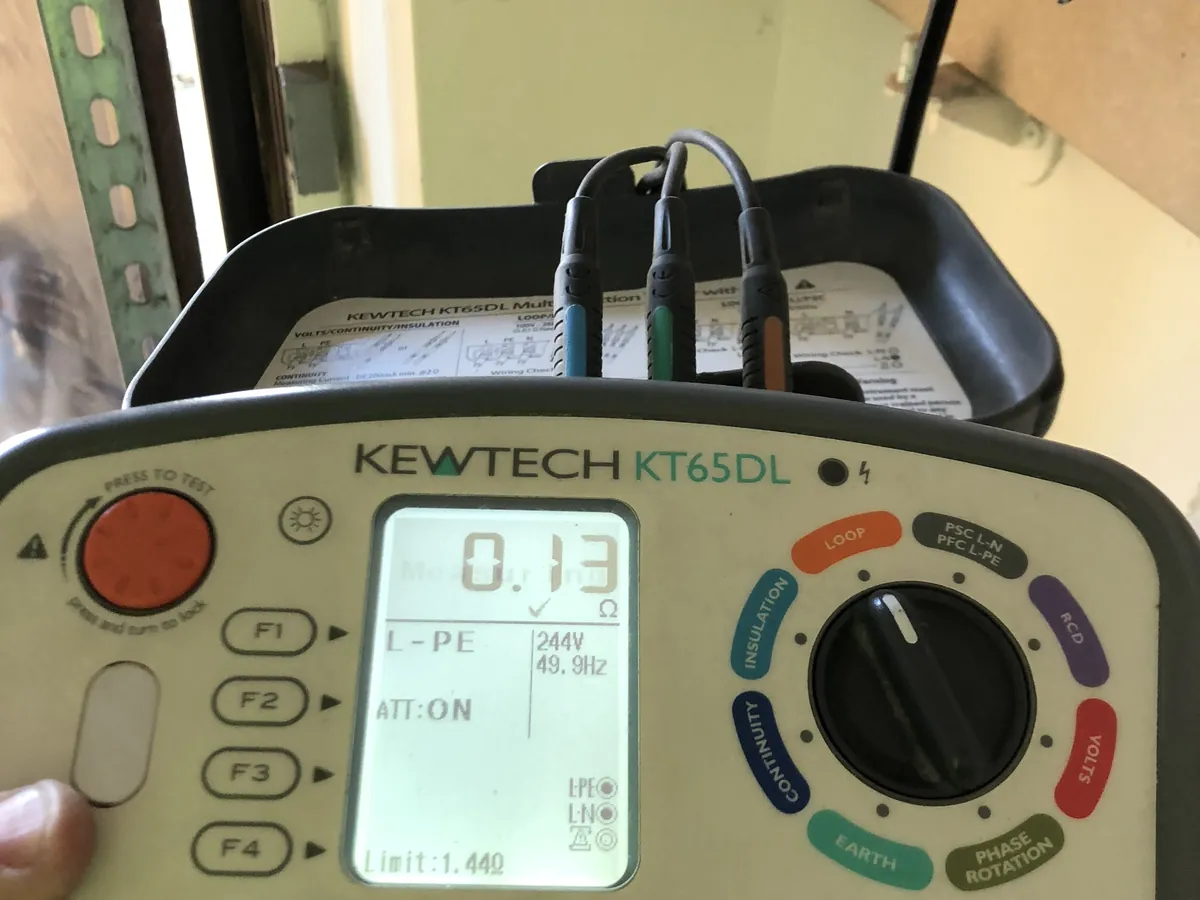
PAT testing (portable appliance testing) is the inspection and testing of electrical equipment that plugs in: computers, monitors, kettles, extension leads, chargers, heaters and power tools. We test, label and record every item, and give you a report for your records.
Who we test for in London
- Offices and shared workspaces, including occupied floors in managed buildings.
- Construction sites: site offices, welfare units and site equipment, on a regular cycle.
- Landlords of furnished lets, HMOs and social housing, where you supply the appliances.
- Schools, churches, shops and community buildings. See our PAT testing page.
What we do
- Formal visual inspection of each appliance, plug, cable and casing for damage, wear, overheating or incorrect wiring.
- Electrical tests with calibrated instruments, as the item needs: earth continuity, insulation resistance, polarity and a functional check.
- Labels on every item showing pass or fail, the test date and when it’s next due.
- A full report listing every item, where it is, the results, and any failures or observations.
Testing means switching each item off for a few minutes. For busy offices we can test on a day your team works from home, so nobody loses their desk, and we ask that all equipment is on site and accessible.
The rules
No law names “PAT testing” or sets a fixed interval. The Electricity at Work Regulations 1989 require employers to maintain electrical equipment so it doesn’t cause danger, and inspection and testing is how most businesses show they’ve done that. How often depends on the equipment and how it’s used: a site drill needs checking far more often than an office monitor. The IET Code of Practice for In-Service Inspection and Testing of Electrical Equipment is the guide we follow.
Social landlords in England must now check electrical equipment they supply to tenants, alongside the EICR. For tenancies that existed before 1 December 2025, the first check is due before 1 November 2026. Private landlords aren’t legally required to PAT test, but it’s the simplest way to show supplied appliances are safe.
Recent London examples
- Holborn (WC2): annual PAT testing across two occupied office floors for a professional body, plus a one-off EICR on one floor, done on a work-from-home day.
- Wembley (HA0): EICR and PAT testing of a development’s site office every three months, for the main contractor.
We also run EICR programmes across London: more than 1,200 booked at London addresses since 2024.
For the building’s fixed wiring, see fixed wire testing; for escape lighting, emergency lighting testing.
Questions we’re asked
Is PAT testing a legal requirement in London?
No law names PAT testing, but the Electricity at Work Regulations 1989 require employers to maintain electrical equipment so it is safe. Regular inspection and testing is how most businesses show they have done that.
How often should PAT testing be done?
It depends on the equipment and how it is used. Office equipment needs testing far less often than tools on a building site. We follow the IET Code of Practice and agree a cycle with you.
Can you PAT test without disrupting the office?
Yes. Each item is only off for a few minutes, and for busy offices we can test on a day your team works from home.
Do landlords need PAT testing?
Social landlords in England must now check electrical equipment they supply, alongside the EICR. Private landlords are not legally required to, but it is the simplest way to show supplied appliances are safe.
What do I get after PAT testing?
Every item is labelled with its result and the next test date, and you get a full report listing each item, where it is, the results and any failures.
Written by SEGplc. Last updated 21 October 2026.
Need it done by a date?
Tell us the deadline. We’ll tell you honestly whether we can hit it — and we usually can.