

- Home
- Keypad entry at home
Keypad door entry for your home
Three ways to get a code on your front door, and how to make it look like it belongs there.
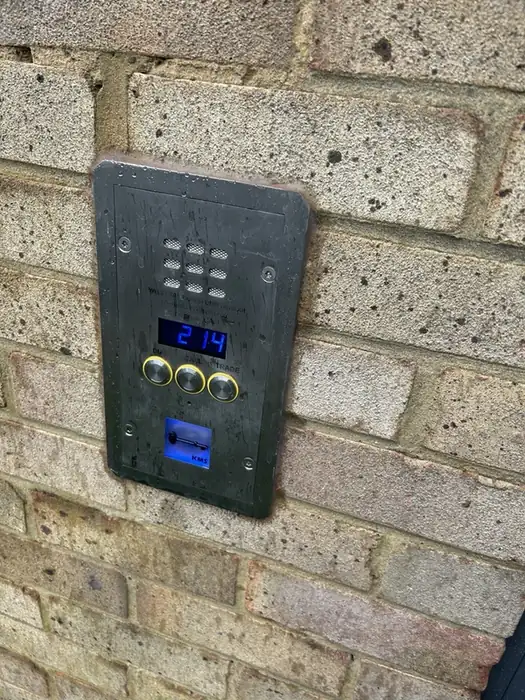
A homeowner in St Albans wrote to us in October: she wanted a keypad on the front door of a detached house, and she wanted it to blend in rather than look like an office. That is a fair ask, and there are three quite different ways to do it.
Your options
| Option | What it is | Best for | Rough cost, fitted |
|---|---|---|---|
| Smart lock with keypad | Replaces or sits over the existing lock. Battery powered. PIN, fingerprint, phone or key. | Most houses. No wiring. Keeps the original door and often the original key. | Lowest |
| Electric strike or maglock with a keypad | The frame holds the door; a flush keypad on the wall releases it. Wired to a small power supply inside. | Doors you want to work like a block entrance: codes for cleaners, carers and deliveries, or a side gate. | Middle |
| Access control system (e.g. Paxton) | Keypad or fob reader, a controller indoors, and software or an app to manage who gets in and when. | Larger homes, annexes, home offices, and anyone who wants a log of who came in. | Highest |
For a single front door on a detached house the first option is usually right, unless you want it tied into gates, a garage or a second entrance, in which case a small Paxton system does all of them from one app. We install Paxton on blocks of flats and commercial doors every week and fit the same kit at home.
Making it blend in
- Flush keypads set into the wall or the door frame rather than a box on the surface.
- Colour. Black, white, stainless and bronze finishes are standard; some ranges come in RAL colours to match the door.
- Hide the reader. A fob reader can sit behind a panel; a keypad can be on the inside of a porch.
- Keep the handle and key. Most smart locks keep a key override, so the door looks unchanged from the street.
Power and wiring
Smart locks run on batteries that last six to twelve months. Wired options need a 12 V or 24 V supply from a small unit inside, which we feed from a fused spur. On a wired system we also fit a release inside so the door opens freely in a fire, and a battery backup if you want the keypad to work through a power cut. If you already have a video doorbell, the keypad and the doorbell can share a transformer; see doorbell problems.
Send us a photo of the door, the frame and the hall side and we will tell you which option suits it. Use the quote form or call.
Questions we’re asked
Can you put a keypad on an ordinary house front door?
Yes. A battery smart lock needs no wiring and keeps the door as it is. A wired keypad with an electric strike or maglock gives you the same control as a block entrance. We fit both.
Will a keypad lock look out of place on a period house?
It doesn't have to. Flush keypads, matching finishes and keeping the original handle and key override make most installations hard to spot from the street.
What happens if the batteries go flat or the power goes off?
Smart locks warn you weeks ahead and have a key override; most can be powered from a phone charger in an emergency. Wired systems get a battery backup, and the door always opens freely from the inside.
Can I give different codes to different people?
Yes. Even basic keypads take several codes; smart locks and Paxton let you set codes that only work at certain times, and delete them from your phone.
Can the same system control my side gate and garage?
Yes. A small access control system runs several doors and gates from one app, with one fob or code for all of them.
Is a keypad secure?
Choose one with a tamper alarm and a lockout after wrong attempts, and change codes when someone no longer needs access. A keypad is no weaker than a key; it is the lock behind it that matters, so we fit it with a proper British Standard lock.
Written by SEGplc. Last updated 1 November 2026.
Need it done by a date?
Tell us the deadline. We’ll tell you honestly whether we can hit it — and we usually can.